


This article explores Jean Piaget’s ideas on the relationship between language and thought, showing how the Swiss psychologist differentiates between the representational and social functions of language. According to Piaget, although language plays an important role in structuring and transmitting ideas, thought is primarily rooted in the individual’s sensorimotor actions. Far from being the origin of thought, language acts as a tool for formalization and socialization, thus complementing cognitive development.
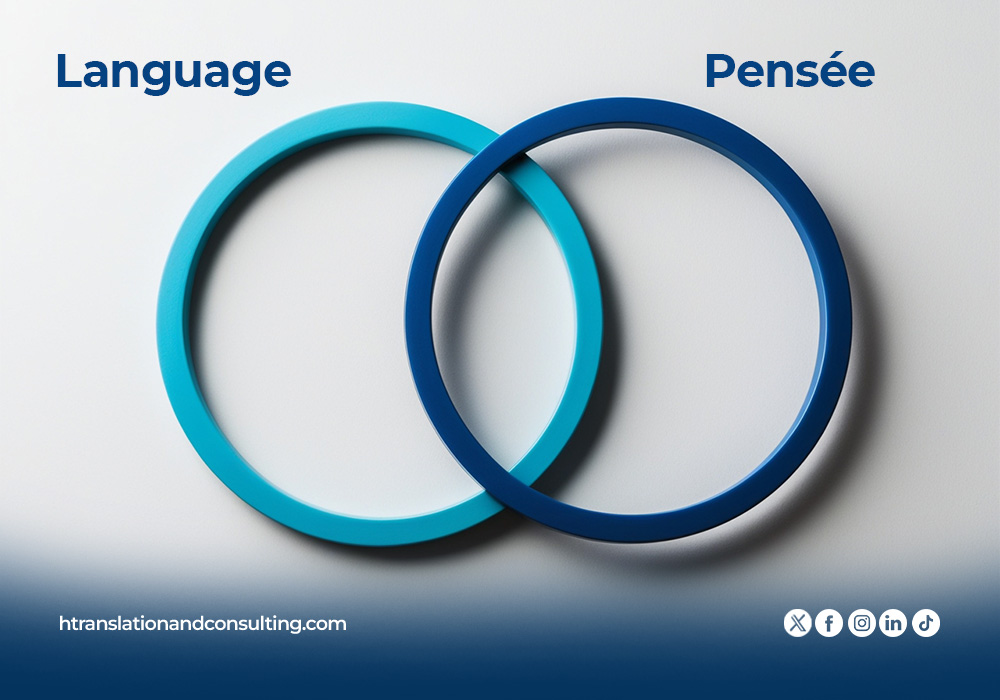
Jean Piaget, the founder of developmental psychology, profoundly influenced studies on the relationship between language and thought. For Piaget, language is certainly a powerful instrument of representation and communication, but it is neither the origin nor the primary driver of logical thought. As a fundamentally social process, language allows us to formalize concepts, structure thought, and facilitate interpersonal exchanges. However, according to Piaget, thought is rooted in the individual’s sensorimotor actions, long before language emerges. This perspective distinguishes between the representational function of language and its role in the development of logical operations, an area where Piaget identifies complex links between cognitive development and language acquisition.
From Piaget’s perspective, language is a semiotic system among others, enabling the representation of ideas, the organization of concepts, and the communication of experiences. According to Piaget, the acquisition of words and syntactic structures is insufficient to guarantee the understanding of logical operations, which are constructed through action and interaction with the physical world. Language contributes to thought, but it does not produce it; it is a “special case of the semiotic function” that takes its place alongside other forms of representation, such as symbolic play or imitation. Thus, even before learning to speak, children develop action schemas that will become the foundations of later logical structures.
Piaget thus distinguishes two distinct roles of language: its role as a system of signs and its role as a means of social communication. As a system of signs, language offers arbitrary and conventional symbols that allow for powerful abstraction. However, the appropriation of logical concepts involves an internal activity of cognitive construction that goes beyond the mere mastery of words. For example, knowing how to use words to express relations of quantity or comparison does not guarantee an understanding of the concepts of conservation or transitivity, which are fundamental logical operations. Piaget argues that these operations are constructed primarily through action, even before being linguistically represented.
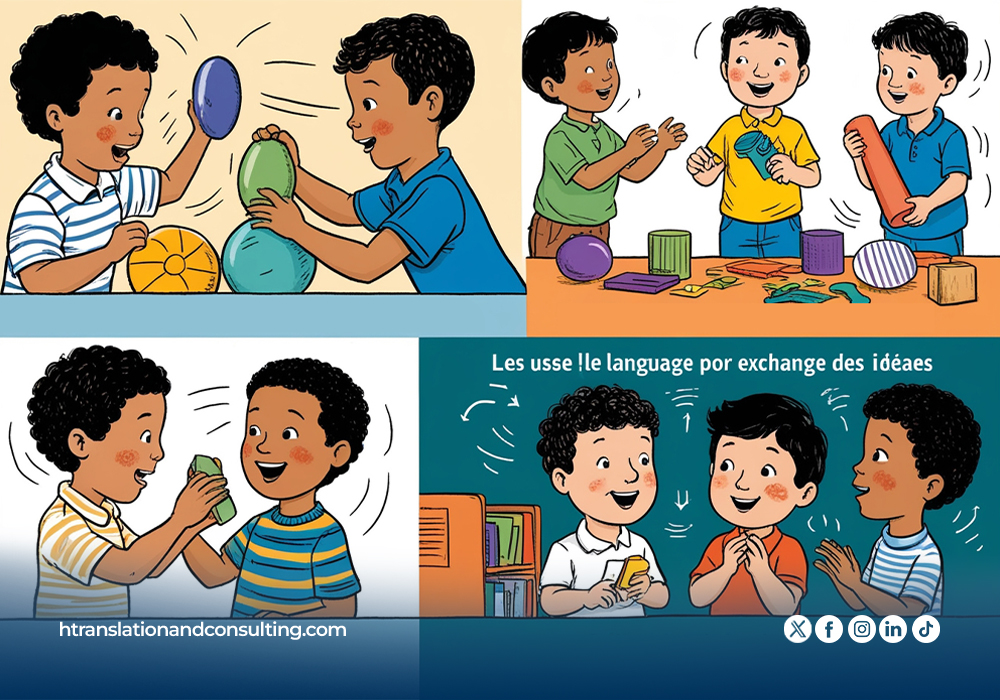
In examining deaf children and their acquisition of logical concepts, Piaget emphasizes that fundamental operations of thought, such as classification, seriation, and spatial relations, develop even in the absence of formal language. These children, although delayed in certain skills due to communication barriers, demonstrate a progression similar to hearing children in the development of basic logic. For Piaget, this shows that action patterns and sensorimotor interactions are sufficient to initiate the foundations of logical thought, thus highlighting the autonomy of cognition from language.
However, Piaget also recognizes the importance of language for the completion of formal and propositional operations at the stage of adult thought. At this level of development, language plays a crucial role in the formalization and structuring of advanced cognitive operations, enabling individuals to manipulate abstract ideas and make complex hypotheses. Language thus contributes to socializing thought, facilitating the exchange of perspectives, and fostering objectivity in knowledge. The discussion and confrontation of ideas, made possible by language, create a space for the collective development of concepts and encourage reflective thinking, essential to formal logic.
Thus, Piaget conceives of language as a tool that complements, but does not determine, cognitive development. Logico-mathematical thought, which he considers a universal invariant, develops independently of the particular linguistic structures of a given language. However, language provides a framework within which thought can be formally expressed, and it facilitates the cultural transmission of concepts. In this context, Piaget sees language as a means of strengthening and refining thought, allowing individuals to formalize and transmit ideas within a social and intersubjective framework.
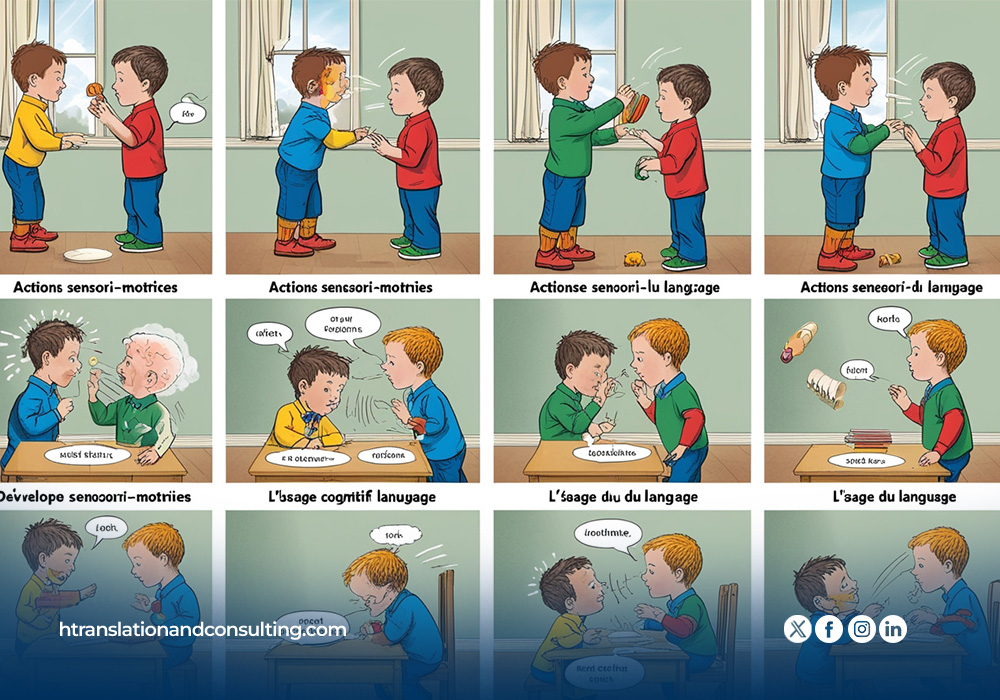
In conclusion, Jean Piaget proposes a view of language as one cognitive function among others, but one that is neither sufficient nor necessary for thought. Thought originates in the child’s actions and sensorimotor schemas, but language becomes a vehicle for the development and socialization of complex cognitive operations. By articulating the representational and social dimensions of language, Piaget offers a nuanced understanding of the relationship between language and thought, highlighting the richness of human cognitive activity and the constructive nature of intellectual development.
Jocelyn Godson HÉRARD, Copywriter H-Translation