


This article, a translation of Jocelyn Godson Hérard’s work submitted to the Le Paradis Haïtien essay contest (October 2024), explores the fundamental role of Creole language and culture in constructing and reinforcing the Haitian narrative. By tracing the origins of Creole and highlighting its impact on identity and memory, it demonstrates how this unique linguistic and cultural heritage can unite Haitians and enhance their image internationally.
Introduction
Language and culture are two fundamental elements of a people’s heritage, representing what its members share in common. Sociologists define culture as “what a group of individuals possesses together, what unites and binds them.” UNESCO adds that, in a broader sense, culture encompasses the spiritual, material, intellectual, and emotional dimensions that allow us to identify a society or social group. This includes art, literature, science, but also lifestyles, laws, value systems, traditions, and beliefs. This definition highlights the importance of culture and its inseparable role in a people’s identity. There is no people without culture, just as there is no culture without a people.
Every people expresses its culture in a unique way, through a variety of activities. One of the most fundamental means is language. Language is an oral code used for communication. According to Ferdinand de Saussure, the Swiss linguist, language is a system of signs, each sign having two aspects: the signifier (the sound image) and the signified (the concept). Saussure explains that the link between a sign and what it designates is arbitrary, which explains why different languages use different words to name the same reality (for example, “door” in English, “puerta” in Spanish). He concludes that signs exist thanks to a social convention, and that language is a social institution shared by a group.
Thus, language and culture appear as two inseparable heritages of the same social group. But their relationship goes beyond this simple coexistence. In the 1960s, anthropologists Edward Sapir and Benjamin L. Whorf, studying Native American languages, proposed a theory known as the Sapir-Whorf hypothesis. According to this hypothesis, the language we speak influences our perception of the world and our way of interpreting our experiences. Although this theory has been criticized, contemporary studies, such as those by Panos Athanasopoulos, confirm that speakers of different languages describe and perceive the same events in distinct ways.
This article explores this deep link between language and culture by focusing on Creole language and culture, as well as their role in constructing and reinforcing the Haitian narrative.
What is Creole language and culture?

Creole language and culture emerged in the context of European colonization and the triangular trade during the 16th and 17th centuries. Research shows that the word “Creole” comes from the Portuguese crioullo or the Spanish criollo, both derived from the Latin creare, meaning “to create.” Originally, the term referred to Europeans born in the colonies, before expanding to encompass everything emanating from those territories, including languages and cultures.
Today, the term “Creole” is primarily used to refer to languages that originated in the colonies. However, historically, it also encompasses cultural aspects. According to Fleischmann (2020), Creole languages and cultures have a particular affinity with islands, where they serve a more pronounced identity-forming function. On the continents, Creole languages mainly serve as tools for communication between different ethnic groups, while on islands, they become profound markers of identity, reflecting local life and its cultural integration.
Creole language and culture to strengthen the Haitian narrative
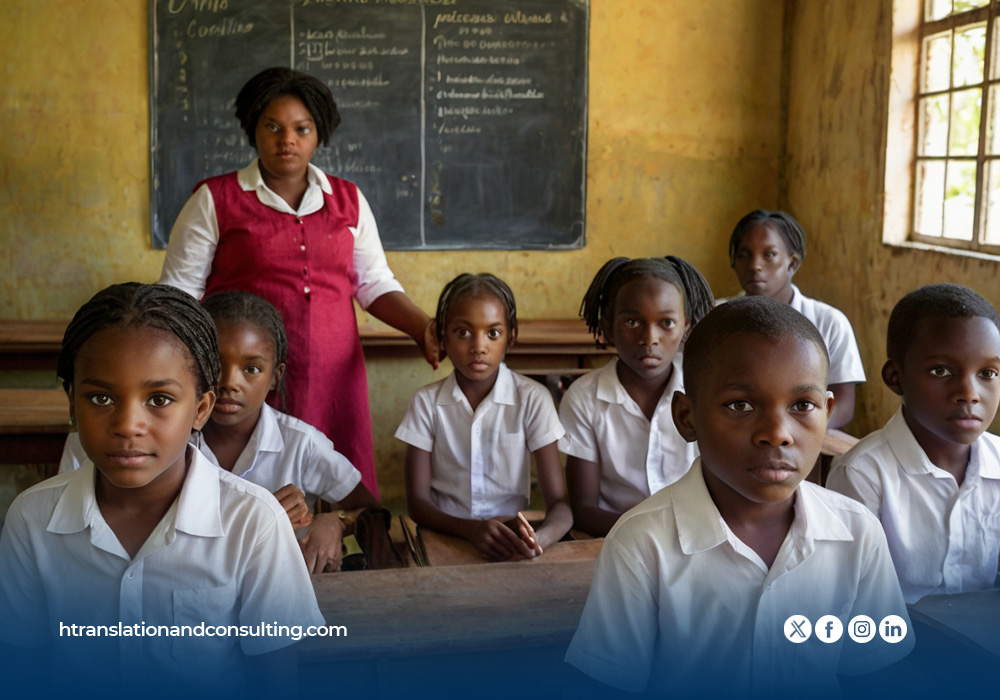
Creole language and culture constitute the essence of Haitian identity. As a language born in a colonial and traumatic context, Haitian Creole bears traces of the history of the Haitian people, often unconscious. Lamaison and Chapellon (2016) explain that the deportation of Africans to the colonies stripped them of their cultural and identity markers, plunging them into a state of dehumanization. In this void, the enslaved developed complex defense mechanisms, including the creation of a new language: Creole. Forged in pain, Creole carries within it the memory of these traumas and continues to tell a collective story.
In this context, Haitian Creole plays a central role in the construction of the national narrative. According to the Sapir-Whorf hypothesis, language is the filter through which we perceive and interpret the world. Creole, as a structuring element, enabled slaves to overcome dehumanization and rebuild their humanity.
To strengthen the Haitian narrative, it is crucial to recognize Creole as the heart of Haitian cultural identity. Its increased use in literature, media, and education could reinforce Haitians’ attachment to their culture and history. Furthermore, preserving Creole traditions, particularly through stories, proverbs, and songs, can transmit Haitian values from generation to generation.
On the international stage, promoting Creole language and culture can also enhance Haiti’s image. By showcasing this unique heritage, Haiti can draw attention to its cultural riches and strengthen its global influence.
Conclusion
Creole language and culture are powerful tools for building and strengthening Haitian identity. They bear witness to the resilience of a people and their capacity to transform pain into cultural richness. By fully integrating Creole into the national narrative, Haiti can reclaim its history while projecting an authentic and powerful image on the international stage.
Jocelyn Godson HÉRARD, Copywriter H-Translation