


This article is an expanded account of Benoît Virole’s study on sign language, published in Les Lettres de la SPF in 2018. Through an in-depth exploration of its structure, origins, and cognitive implications, it highlights the richness of this visual and symbolic language. Far more than a means of communication for deaf people, sign language questions the very foundations of human language and offers a new perspective on symbolization and cognition.

Sign language is a complex and fascinating linguistic system, using vision as a means of reception and gestures as a mode of expression. Far from being a simple communication tool for deaf people, it reveals fundamental aspects of the nature and origins of human language. Its structure and use allow us to redefine our understanding of symbolization and cognitive expression.
A visual and natural language
In profoundly deaf children, the deprivation of spoken language often leads to the spontaneous emergence of a rich and meaningful gestural system. This development, observed even in hearing children born to deaf parents, testifies to the biological basis of gestural communication. This suggests that language, whether spoken or gestural, rests on an innate capacity for symbolization and structuring. Sign languages, developed in deaf communities or taught in institutional settings, are enriched by cultural and linguistic conventions that transform this natural basis into a structured linguistic system.
Contrary to a long-held belief, human language is not necessarily audiophonological. Sign languages demonstrate that the mode of transmission is contingent, while symbolic capacity is constant. This reality challenges traditional assumptions about the link between language and hearing and opens new perspectives on the universality of language.
An origin rooted in cognition
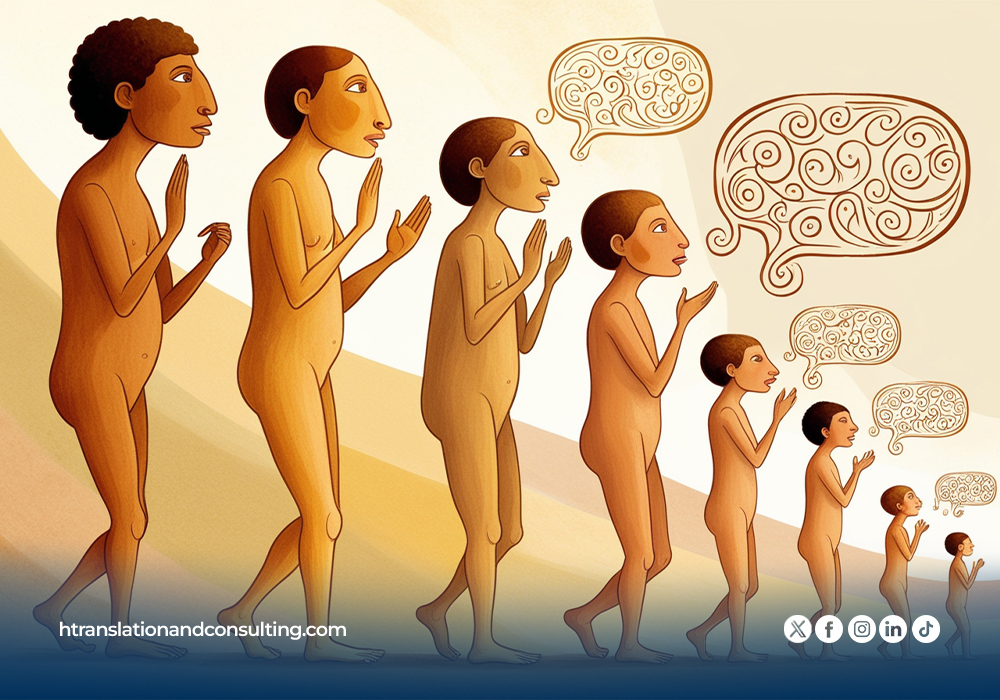
Historically, gestural communication may have played a crucial role in human evolution. While spoken language offers obvious advantages, such as its range in the dark or over long distances, sign language possesses unique strengths. Silent, it is ideal for discreet communication, and its visual dimension allows for an expressive richness that is difficult to match. Modern sign languages, although stemming from a sociocultural development, still bear the traces of this intimate connection between gesture and symbolic thought.
Sign languages also demonstrate the flexibility of the human brain. They activate brain areas similar to those involved in spoken language, while relying more heavily on the right hemisphere to process their spatial aspects. This particular lateralization illustrates the brain’s ability to adapt to different modes of linguistic expression.
The structural richness of sign languages
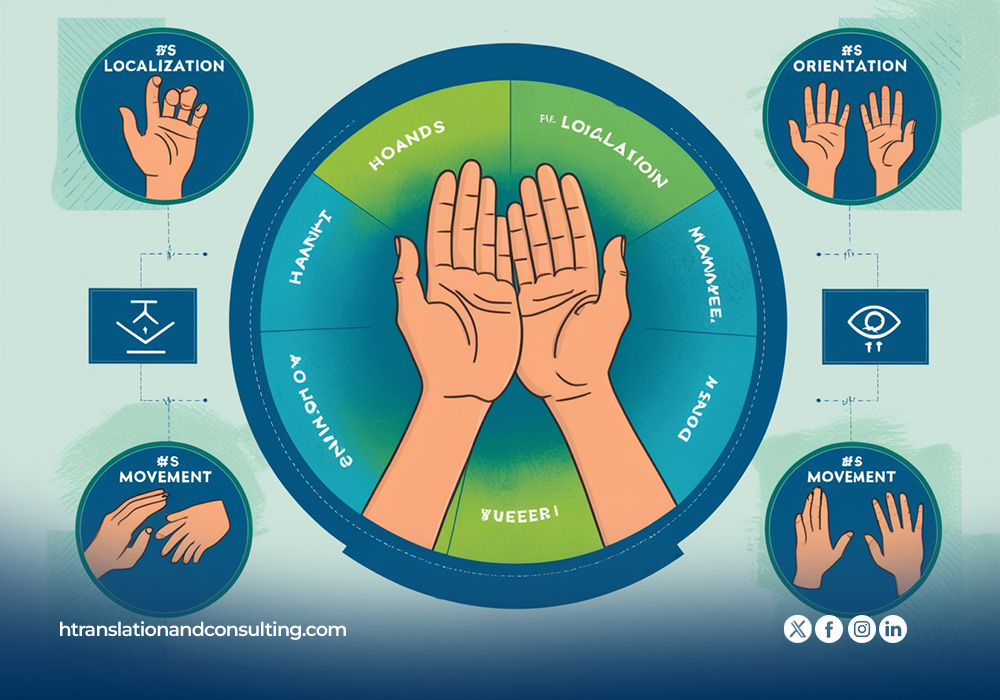
Linguistically, sign languages offer a structural richness that equals, or even surpasses, that of spoken languages. The parameters for sign formation—hand configuration, location, orientation, and movement—function as minimal units similar to phonemes in spoken languages. These parameters allow for a high degree of generativity, that is, the ability to produce an infinite number of combinations from a limited number of elements.
One of the most fascinating aspects of sign languages is their iconicity. Unlike spoken languages, where words are often arbitrary, gestural signs frequently have a visual or metaphorical relationship to what they represent. For example, a sign might mimic the shape or movement of the object or concept it signifies. This iconic property gives sign language an immediacy and transparency that enriches its communicative function while demonstrating the close interaction between perception and cognition.
A cognitive and semiotic perspective
Sign languages also reveal fundamental aspects of human thought. They exploit spatial dimensions in a unique way, allowing for a simultaneity of expression that is impossible in spoken language, limited as it is by temporal sequentiality. This four-dimensional organization (three spatial dimensions plus time) offers a direct window into the spatial structure of human thought, often hidden in spoken languages by their linearity.
More broadly, sign language demonstrates that thought and language are not solely symbolic or arbitrary. They rely on perceptual and motor patterns deeply rooted in our bodily experience. For example, gestures representing separation or merging directly translate abstract concepts such as division or unity, suggesting that these notions are grounded in concrete physical experiences.
A new vision of symbolization
The study of sign languages has led to a redefinition of symbolization itself. Far from being limited to a disembodied abstraction, symbolization is based on perceptual and motor structures organized into dynamic systems of relationships. These systems reflect not only the objects of the world, but also human interactions and intentions.
In psychoanalysis, this perspective has led to a reinterpretation of mental processes such as dreaming and symptom formation. Like dreaming, sign language translates abstractions into figurative images, offering a form of symbolic expression that directly links meaning and perception. This capacity highlights the continuity between body, thought, and language, and opens new avenues for understanding disorders of communication or symbolic development.
An invaluable contribution to cognitive and social sciences
Finally, sign languages are not merely objects of linguistic or cognitive study. They are also living testaments to human diversity and adaptability. Their recognition and appreciation contribute to greater inclusion of deaf communities and offer valuable educational and therapeutic tools for all individuals with communication difficulties.
Thus, sign languages do not simply reveal another facet of language. They invite us to reconsider our fundamental conceptions of communication, thought, and culture, showing that human language, in all its richness, is much more than a simple instrument of speech.
Jocelyn Godson HÉRARD, Copywriter H-Translation