


Paraphrase, far from being a simple repetition of meaning, is a complex process in which language and discourse intertwine. This in-depth study reveals how reformulation mechanisms contribute to the dynamic construction of meaning, subtly transforming the message while preserving its essence. From formal linguistics to discursive practices, discover the many facets of this fundamental phenomenon of human communication.
Paraphrase is a complex linguistic phenomenon situated at the intersection of language and discourse. This reformulation activity, omnipresent in language use, deserves particular attention because it reveals the fundamental mechanisms of meaning construction and transmission.
From a linguistic perspective, paraphrase is a semantic relationship between utterances, allowing for the establishment of formal equivalences within the language system. This systemic dimension is manifested particularly through the syntactic transformations and predicative relations that structure utterances. Linguistic analysis thus makes it possible to highlight the formal mechanisms that underlie the equivalence relations between different formulations.
The discursive dimension of paraphrase proves particularly rich. As an activity of reformulation, it is not limited to a simple reproduction of the initial meaning but invariably involves a semantic shift. Each reformulation constitutes a reconstruction of meaning, influenced by the context of utterance and the communicative objectives. This discursive progression is particularly noticeable in science communication practices, where reformulation allows specialized content to be adapted to different audiences.
The parallel between paraphrasing and translation proves particularly illuminating. Just as interlingual translation requires adaptation that goes beyond simple word-for-word substitution, intralingual paraphrasing involves a process of reconstructing meaning that takes into account the specificities of the communication context. This analogy allows for a better understanding of the challenges of reformulation in specialized communication situations.
The metalinguistic dimension of paraphrasing deserves particular attention. The linguistic markers that introduce reformulations (such as “that is to say,” “in other words,” “in other words”) reveal a conscious activity of identifying semantic elements. These markers demonstrate a complex cognitive operation by which the speaker explicitly establishes semantic equivalences.
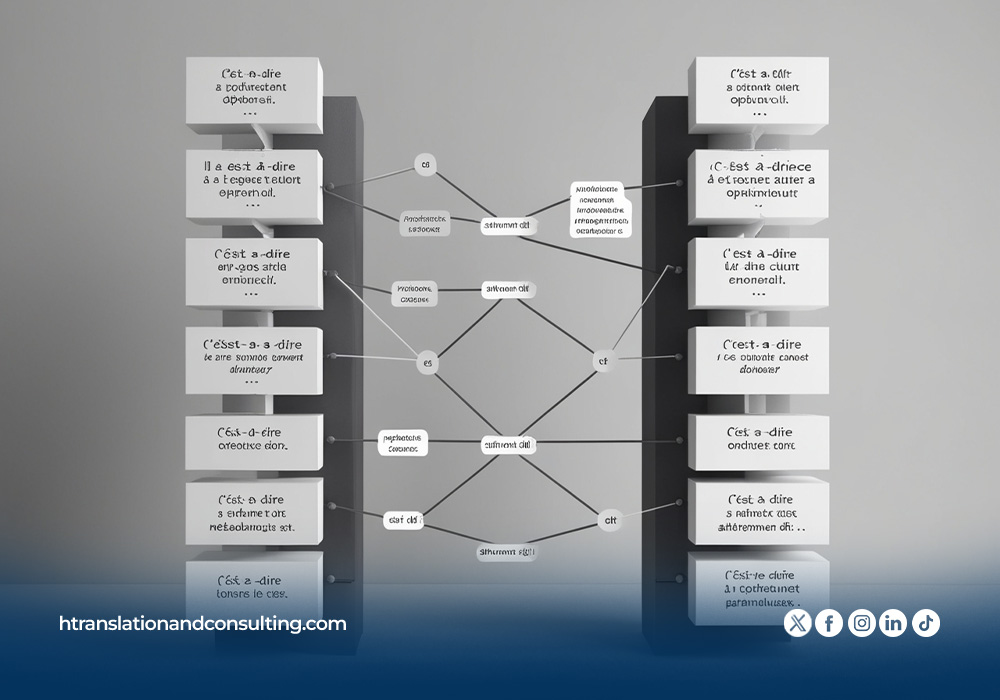
Analyzing paraphrasing situations highlights the complexity of semantic identification processes. The semantics attributed to reformulated expressions result from a series of cognitive operations involving the reconstruction of the initial meaning and its adaptation to the new context of utterance. This dynamic reveals the fundamental tension between identity and difference that characterizes paraphrasing.
Paraphrase thus becomes part of a dialectic between the same and the other, between the preservation and the shift in meaning. This inherent tension manifests itself in the coexistence of two dimensions: on the one hand, metalinguistic identification, which posits an equivalence between expressions, and on the other hand, discursive movement, which inevitably generates semantic variations.
The implications of this analysis for understanding communication processes are considerable. In particular, it allows for a better understanding of reformulation mechanisms in specialized contexts, such as science communication or pedagogy, where the ability to reformulate effectively is an essential skill.
In conclusion, paraphrase appears as a complex phenomenon that cannot be reduced to either a simple linguistic relationship or a purely discursive practice. Understanding it requires considering multiple dimensions that are intertwined in language use. This integrative approach opens up fruitful perspectives for the study of the processes of meaning construction and transmission in communication.
Jocelyn Godson HÉRARD, Copywriter H-Translation