


The rule that “the masculine prevails over the feminine” is often perceived as an immutable principle of the French language. Yet, this grammatical norm has not always existed. For a long time, proximity agreement, which made adjectives agree with the nearest noun, coexisted with other forms of agreement. So, why and how did the masculine eventually come to dominate? This article explores the origins and implications of this controversial rule, situated between linguistic tradition and sociopolitical legacy.
The question of whether the masculine has always “prevailed” over the feminine in the French language cannot be addressed in a simple and unequivocal way. Far from being an immutable rule since its origin, the grammatical dominance of the masculine is the product of a historical and social construction, influenced by the prevailing conceptions of each era. The history of the language shows that agreement rules have evolved over time, sometimes as a result of debates that went far beyond linguistics and touched upon social representations of masculinity and femininity.
Language, as a social phenomenon, is subject to constant dynamics of change. It adapts to usage, reflects mentalities, and can also be a battleground for ideological struggles. For several decades, the debate on the supposed sexism of French has intensified, particularly around the issue of adjective and past participle agreement. The current rule, according to which “the masculine prevails over the feminine,” has not always been the case. Its establishment resulted from a process at the intersection of linguistics and societal conceptions of gender hierarchy.
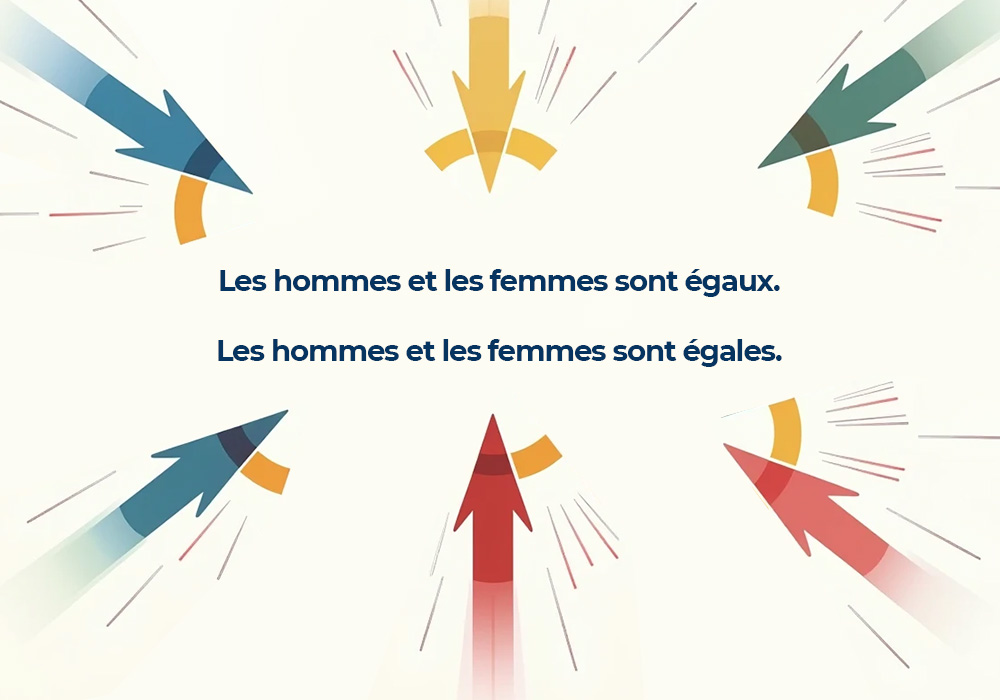
In the history of French, grammatical agreement was not always based on the superiority of the masculine. Until the Middle Ages, the dominant rule was that of proximity agreement: an adjective or participle agreed with the nearest noun, regardless of its gender. Thus, a sentence like “Men and women are equal” would not have been considered incorrect. This usage, inherited from Latin, persisted until the 17th century and was employed by many authors, including some members of the French Academy. It coexisted with another form of agreement, sometimes arbitrary, which varied according to the writers and the linguistic sensibilities of the time.
However, from the 17th century onward, grammarians, under the influence of academic norms, gradually abandoned proximity agreement in favor of the current rule. This evolution was not driven by purely linguistic reasons, but rather by social representations that valued the primacy of the masculine. Claude Favre de Vaugelas, one of the first members of the French Academy, saw no problem in writing “le cœur et la bouche ouverte” (with an open heart and mouth). But others, like the Jesuit Dominique Bouhours, believed that “when the two genders meet, the nobler one must prevail.” This viewpoint, widely held at the time, was based on a hierarchical worldview, where the masculine symbolized strength and nobility, while the feminine was perceived as subordinate.

This shift from a flexible rule to a rigid norm was enshrined in the 18th century, notably by the grammarian Nicolas Beauzée, who declared that “the masculine gender is considered nobler than the feminine because of the superiority of the male over the female.” This statement aptly illustrates how linguistic conventions have been shaped by ideologies that extend beyond grammar alone. By imposing the predominance of the masculine, a patriarchal worldview was thus established, in which language served to reflect and reinforce power relations between the sexes.
Today, this rule is being challenged by certain linguistic and feminist movements. Several alternative proposals have emerged, including majority agreement, which consists of making the adjective agree with the most frequent noun in a list, or inclusive writing, which aims to make the feminine visible through doublets or marked forms, such as the use of the mid-dot (example: “les candidat·e·s”). Others advocate a return to proximity agreement, arguing that it is a historical tradition of French.

However, these proposals are not universally accepted and raise both practical and theoretical challenges. Proximity agreement, while historically established, can be confusing in certain contexts. For example, in a sentence like “Registered voters will be able to vote,” it could be understood that only women are concerned by registration. Similarly, inclusive writing poses problems of readability and oral transmission, which hinders its widespread adoption.
Beyond linguistic considerations, these debates reflect a broader issue: the representation of gender in society. Language structures our perception of the world and conveys deep-rooted cultural norms. Modifying its agreement rules is therefore not simply a grammatical choice, but rather a desire to transform mindsets and collective representations.
In short, the rule that “the masculine prevails over the feminine” has not always existed and is not an immutable principle of French. It is the product of a historical evolution marked by socio-political influences. Its maintenance or its questioning goes beyond the strict framework of grammar and is part of a broader reflection on gender equality and how language reflects—or perpetuates—power relations. The question is therefore not only which rule to apply, but also which models of thought we wish to embed in our linguistic practices.
Jocelyn Godson HÉRARD, Copywriter H-Translation