


This article explores the human capacity for language, a universal and fundamental ability, through a synthesis of the theories and perspectives that have shaped modern linguistics. Inspired by Elizabeth Closs Traugott’s original article, published in the journal Diogenes (2010), it offers an enriched and contextualized view of the major questions that drive this field: from the origin of language to its role in society and human thought. A captivating intellectual journey through biology, cognition, and culture.
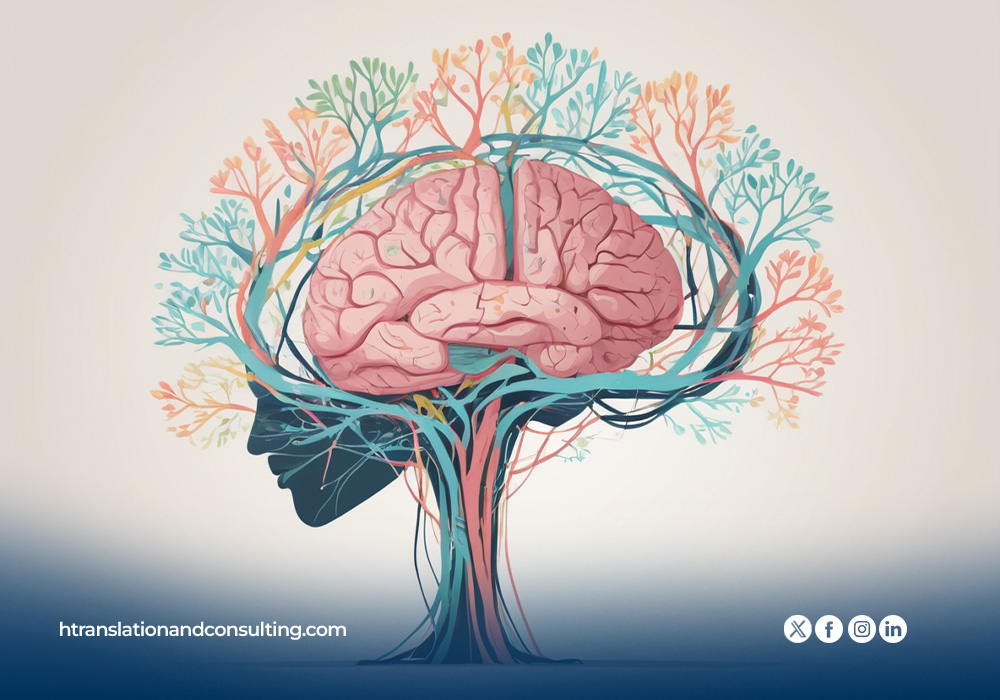
Linguistics, as a scientific discipline, focuses on the study of the human capacity for language, a universal faculty essential to the human condition (Traugott, 2010). This field of research is not concerned with what should be, but with what is: it observes, describes, and analyzes languages in all their diversity and complexity, without attempting to impose norms or judgments. Such an approach situates linguistics within a descriptive framework, far removed from the prescriptive concerns that have long dominated the study of languages.
Historically, the origins of linguistics can be traced back to ancient traditions, such as that of the Sanskrit grammarian Panini in the 4th century BCE. However, as a modern science, it emerged in the 19th century, centered on the comparative analysis of Indo-European languages. This period was marked by the formalization of systematic relationships between these languages, notably through models inspired by the family tree, a metaphor borrowed from the natural sciences and popularized by Schleicher (1861-1862). This work, initiated by figures such as Sir William Jones, paved the way for an evolutionary and systematic understanding of languages, a concept that Darwin himself recognized as valid in The Descent of Man (1871).
Modern linguistics has undergone several major developments. The 20th century saw the rise of structuralist theories, championed by Ferdinand de Saussure, who introduced fundamental concepts such as the arbitrariness of the linguistic sign and the distinction between langue and parole (Saussure, 1916). This work emphasized the systemic nature of languages and their function within societies. Later, the groundbreaking work of Noam Chomsky redefined the discipline by introducing generative grammar, which posits that language ability is an innate capacity, genetically determined and structured by a universal grammar (Chomsky, 1957; 1986).
In parallel, functional approaches have emerged to highlight the importance of context and social uses in the formation and evolution of languages (Van Valin Jr., 2001). Unlike generative theories, which favor an abstract and internal view of linguistic structures, these functional approaches emphasize the interdependence between language and its cultural environment. Studies on speech acts, such as those by Austin (1962) and Searle (1969), illustrate how individuals use language to perform specific social actions, such as making promises or giving orders.
Contemporary linguistics also explores interdisciplinary boundaries, particularly with cognitive science, neuroscience, and genetics. The discovery of genes such as FOXP2 has raised questions about the biological origin of language, although interpretations remain cautious (Crow, 2002). In parallel, the analysis of electronic databases has made it possible to document complex linguistic phenomena and to understand the interactions between linguistic variation and change (Bybee and Hopper, 2001).
The study of language use has also shown that language is essentially dynamic and rooted in bodily and cultural experiences. Cognitive linguistics, developed by researchers such as Lakoff and Johnson (1980), highlights the central role of metaphors and bodily conceptualizations in structuring language and thought. For example, expressions like “to build an argument” or “in the coming days” reflect metaphors grounded in physical and temporal experiences.
Finally, research on linguistic variation, initiated by Labov (1972), has shown that languages are never homogeneous. Their variability reflects social, stylistic, and historical dynamics, which opens the way to studies on how languages evolve and adapt over time.
In short, linguistics provides a framework for understanding one of humanity’s most distinctive traits: the ability to communicate, create, and transmit ideas through language. By studying this ability, it goes beyond academic questions to shed light on practical issues such as language learning, language disorders, and the preservation of endangered languages. The richness and diversity of this field make it a valuable tool for better understanding the complexities of our world and the human condition.
Jocelyn Godson HÉRARD, Copywriter H-Translation