


This article explores linguistic structuralism, a fundamental current that revolutionized the study of language in the 20th century. Based on the work of Ferdinand de Saussure, structuralism conceives of language as an organized system where each element derives its meaning from its relationship to the others. Through the contributions of Jakobson, Troubetskoy, Tesnière, and Hjelmslev, this article highlights the key principles of this approach and its lasting influence on linguistics and other disciplines.

Linguistic structuralism represents a major advance in the understanding of language, proposing a systematic and rigorous approach to linguistic analysis. Stemming from the foundational work of Ferdinand de Saussure, this school of thought views language as a structured system of interrelated elements. In opposition to the philological traditions and diachronic approaches that dominated the 19th century, structuralism prioritizes a synchronic study of language, that is, the analysis of linguistic structures in their current state, independent of their historical evolution. This approach marked a decisive turning point, influencing not only linguistics but also other disciplines such as anthropology, semiotics, and psychology.
One of the fundamental principles of structuralism rests on the distinction made by Saussure (1916) between langage, langue, and parole. langage is the general faculty of communication inherent to the human species, while langue is a set of signs and rules specific to a given community. Parole, for its part, corresponds to the individual use that each speaker makes of language. This distinction is essential because it highlights the social and conventional nature of language: a langue does not function as a simple repertoire of words, but as a system in which each element acquires its meaning in opposition to the others.
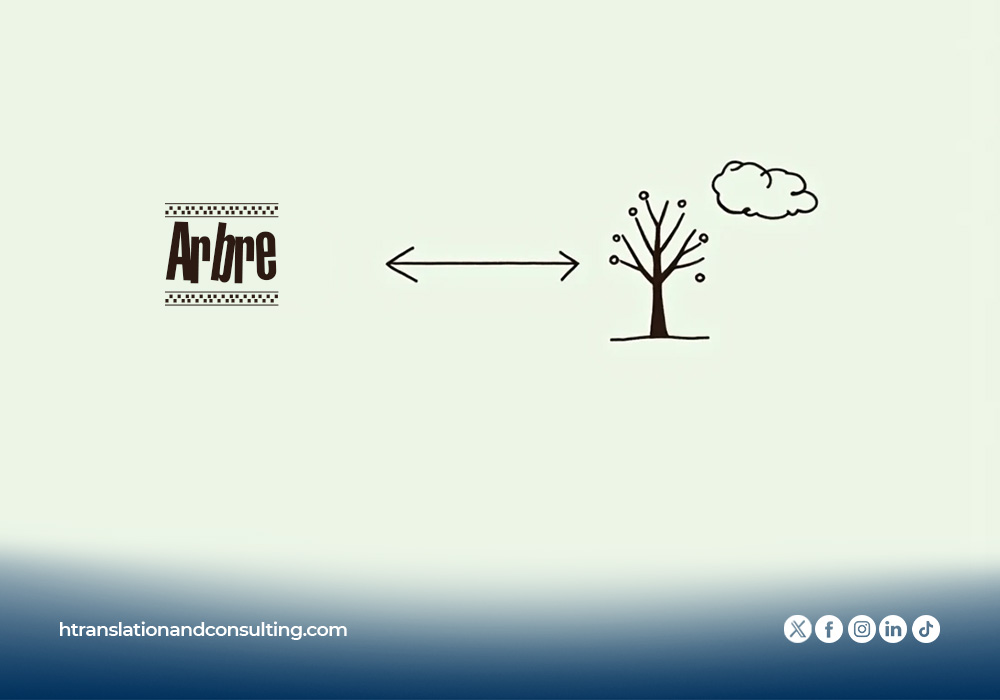
Saussure also developed the notion of the linguistic sign, which he defined as an entity composed of two inseparable components: the signifier (the sound or graphic form of the word) and the signified (the concept it represents). He emphasized the arbitrariness of the sign, that is, the absence of a natural link between a word and its referent in the real world. This idea broke with traditional conceptions of language that saw words as direct reflections of things. Thus, while the word “arbre” (tree) designates a woody plant in French, it could be replaced by any other sound in another language, provided that the speakers agree on this convention.
Another major contribution of structuralism is its emphasis on the relationships between linguistic elements. Saussure distinguishes two types of relationships: syntagmatic and paradigmatic. Syntagmatic relationships concern the linking of linguistic units in an utterance, as in the sentence “The cat sleeps,” where each word is linked to the others according to a precise syntactic order. Paradigmatic relationships, on the other hand, are based on the opposition between elements that can occupy the same position in a given structure. For example, in the sentence “The cat sleeps,” the word “cat” can be replaced by “dog,” “bird,” or “child,” which modifies the overall meaning of the utterance without changing its syntactic structure.
Following Saussure, structuralism was further developed and systematized by several schools and researchers. The Prague School, founded by Nikolai Trubetskoy and Roman Jakobson, applied the principles of structuralism to phonology, highlighting the role of distinctive oppositions between sounds. Trubetskoy (1939) defined the phoneme not as a simple sound unit, but as a set of distinctive features that allow words to be differentiated within a language. Thus, in French, the opposition between /p/ and /b/ is relevant because it distinguishes words like poule (hen) and boule (ball).
Jakobson (1963), for his part, developed a theory of language functions, identifying six elements in any act of communication: the sender (the speaker), the receiver (the listener), the message, the context, the code (the language), and the channel (the medium of communication). He also distinguished several linguistic functions, such as the referential function (centered on information), the expressive function (which expresses the speaker’s emotions), and the phatic function (which serves to establish or maintain contact between interlocutors).
Structuralism also influenced syntactic analysis, notably with Lucien Tesnière (1959), who introduced the notion of syntactic dependency. He demonstrated that the words in a sentence are not juxtaposed randomly, but organized into hierarchical units, where certain elements govern others. For example, in the sentence “Pierre eats an apple,” the verb “eats” is the central element around which the subject (Pierre) and the object (an apple) are structured. This model foreshadows the later developments of Chomsky’s generative grammar, although Chomsky gradually moved away from the structuralist paradigm to adopt a more formalist and cognitive approach.
Structuralism also extended to semantics with Louis Hjelmslev (1943), who proposed an even more abstract analysis of linguistic structures. He distinguished between the plane of expression (linguistic forms) and the plane of content (meanings), and emphasized the idea that language is a network of relations where each element derives its meaning from its oppositions with others.
A key characteristic of structuralism is its synchronic approach, which studies language in its current functioning rather than its historical evolution. This perspective contrasts sharply with 19th-century historical linguistics, which favored the diachronic study of languages by tracing their origins and transformations through time. For Saussure and his successors, language must be analyzed as an autonomous system, where every internal change modifies the entire structure.
Despite its considerable influence, structuralism has been criticized since the 1960s, particularly by functionalist and generativist schools of thought. Some researchers accuse it of underestimating the role of context and social interactions in language use. Others believe it places too much emphasis on the formal structure of language at the expense of the cognitive processes underlying language production and comprehension. These criticisms have led to the development of new approaches, such as pragmatics, which focuses on language use in context, and cognitive linguistics, which explores the links between language and thought.
Despite these challenges, the legacy of structuralism remains fundamental to the study of language. It enabled the establishment of rigorous analytical methods and paved the way for deeper research into the nature of the sign, phonology, syntax, and semantics. Its influence extends far beyond linguistics, touching disciplines such as anthropology with Lévi-Strauss, semiotics with Barthes, and psychoanalysis with Lacan. Even today, many concepts stemming from structuralism continue to inspire work on the structure and functioning of languages.
Bibliographical references
Chomsky, N. (1957). Syntactic Structures . Sheep.
Hjelmslev, L. (1943). Prolegomena to a theory of language . Copenhagen: Nordisk Sprog- og Kulturforlag.
Jakobson, R. (1963). Essays in General Linguistics . Paris: Minuit.
Saussure, F. de (1916). Course in general linguistics . Paris: Payot.
Tesnière, L. (1959). Elements of structural syntax. Paris: Klincksieck.
Troubetskoy, N. (1939). Principles of phonology . Paris: Klincksieck.
Jocelyn Godson HÉRARD, Copywriter H-Translation