


The invention of Creole, born from the violent encounter between African and French languages under the yoke of slavery, allowed enslaved people in the Antilles to reclaim a part of their lost humanity. This article explores the fundamental role of this language in the psychological reconstruction of individuals dispossessed of their original cultures and identities. Through a psychoanalytic analysis, it highlights the importance of this symbolic process in overcoming the collective trauma inherited from this violent period of history.
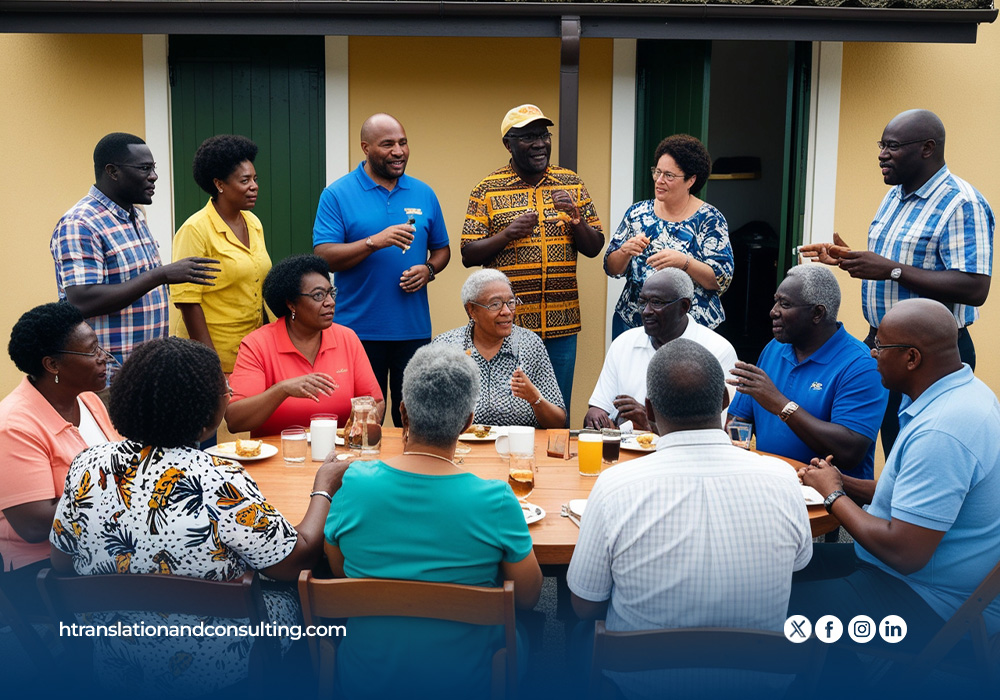
The article entitled “The Invention of the Creole Language Saved Slaves from a State of Dehumanization” by Jeanne Wiltord explores in depth the psychological and social implications of the creation of the Creole language among slaves in the Antilles. It highlights how, in a context of extreme violence and dehumanization, the Creole language not only emerged but also served as a means of resilience and identity reconstruction for enslaved populations.
According to Jeanne Wiltord’s analysis, Creole is central to postcolonial dynamics and the psychological effects of slavery. The author highlights how this language, beyond its communicative function, played a fundamental role in the identity reconstruction of enslaved people in the French West Indies, allowing them to reclaim a part of their humanity in the face of the destructive violence of colonial slavery. It is important to emphasize that the impact of slavery was not limited to physical exploitation; it extended to an attempt at dehumanization through the eradication of their native languages, thus reducing individuals to a state of enforced silence. In this context, the creation of Creole emerges as an act of resilience and reconstruction, a tool for psychological survival.
The formation of the Creole language can be understood as an adaptive response to the extreme symbolic violence imposed by slavery. Slaves, uprooted from their homelands and torn from their original cultures and languages, found themselves in an environment where traditional means of communication were not only impractical but also forbidden. Thus, Creole emerged not simply as a linguistic mixture, but as a space for the recomposition of the symbolic, a way of restoring meaning and coherence to a fragmented and shattered experience. This language allowed slaves to recreate a network of shared meanings, essential for structuring their collective and individual identities.
From a psychoanalytic perspective, Wiltord examines the Creole language through the lens of unconscious subjectivity, highlighting the prohibitions and taboos associated with its use in contemporary social and therapeutic contexts. The injunction, passed down in some families, not to speak Creole, often internalized by successive generations, reveals itself as symptomatic of a protective strategy against a language that touches upon the most intimate layers of human experience. Wiltord associates the use of Creole with a kind of return to the primal proximity of the maternal body, a proximity experienced ambivalently, between desire and anxiety. In this framework, Creole is perceived as a language that is “too immediate,” which risks reactivating early experiences linked to jouissance, a central concept in psychoanalysis that refers to intense sensations beyond pleasure, and often associated with suffering.
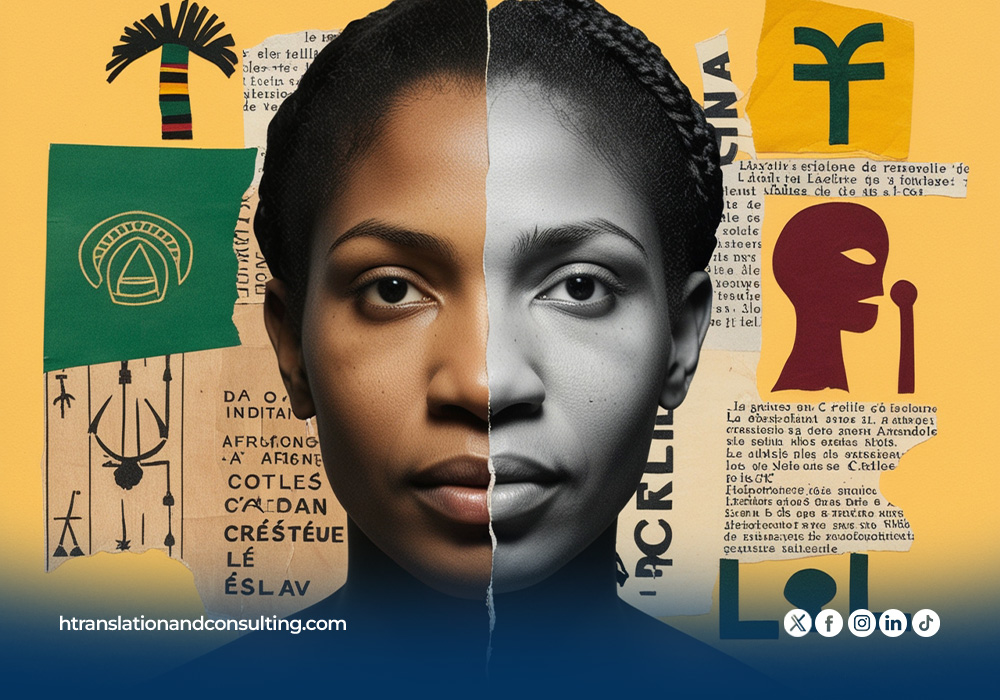
This theoretical approach leads us to reflect on the difficulties of integrating Creole into current psychoanalytic and psychiatric practices in the French West Indies. Wiltord observes that, despite its daily use by many West Indians, Creole struggles to find its place within a therapeutic framework because it evokes unconscious dimensions often considered too threatening to be explored in depth. This raises the question of the effects of Creole-French diglossia on the West Indian psyche, and how this linguistic duality shapes representations of self and world. While Creole is a fundamental element of West Indian cultural heritage, it remains marked by a history of stigmatization and repression, which complicates its full and complete recognition in public and institutional spheres.
Wiltord’s analysis also extends to the intergenerational consequences of the trauma of slavery, a trauma which, according to her, continues to manifest itself in contemporary Caribbean societies. She proposes that this trauma is not transmitted solely through narratives or symbols, but also through repetitive acts and behaviors. These repetitions, manifested as physical violence or unresolved conflicts, reflect an inability to symbolize the initial suffering caused by the destruction of ancestral languages and identities. In this context, Creole has enabled the establishment of a symbolic system, certainly weakened by the constraints of its history, but nonetheless essential for attempting to restore a sense of psychological continuity among the descendants of slaves.
In short, Wiltord’s study highlights the importance of working through memory, both historical and psychological, to break free from the “fixed state of trauma.” This work, which must be based on historical and genealogical research, as well as psychoanalytic approaches, is necessary to make sense of past and present events, and thus foster the construction of a narrative that transcends inherited suffering. The Creole language, as both witness to and vehicle of this resilience, presents itself as a potential lever for reappropriation and healing, provided it is fully integrated and valued in current social and therapeutic practices.
This in-depth analysis demonstrates that the Creole language is not only a tool for communication, but a support for identity reconstruction, a means of reinvesting in the painful history of slavery and of reconstituting a symbolic fabric necessary for the development of the individual and the community.
Jocelyn Godson HÉRARD, Copywriter H-Translation