


Born out of an urgent need for communication within the violent context of colonization and slavery, Haitian Creole embodies a unique process of creolization. This complex linguistic phenomenon gave rise to a new language, resulting from the encounter between African syntactic structures and the European lexicon, particularly French. In this article, we explore the various theories that have contributed to the genesis of Haitian Creole and highlight the importance of its linguistic specificity, which defies simple hybridization models.
Introduction
Creolization is a linguistic phenomenon of rare complexity, at the heart of which lie deeply intertwined historical, social, and linguistic dynamics. Haitian Creole, in particular, bears witness to a unique language formation process that occurred within a context of brutal contact between heterogeneous linguistic groups, dominated by the slave trade and European colonization. Analyzing Haitian Creole therefore requires a multidimensional approach capable of accounting for the various cultural and linguistic substrates that contributed to its genesis. This process is neither a simple lexical transposition nor a one-way evolution, but rather a systemic reconfiguration of pre-existing linguistic elements. In light of recent research, several theories attempt to explain the genesis of Haitian Creole, often adopting opposing perspectives, but each contributes to illuminating some of the underlying mechanisms.
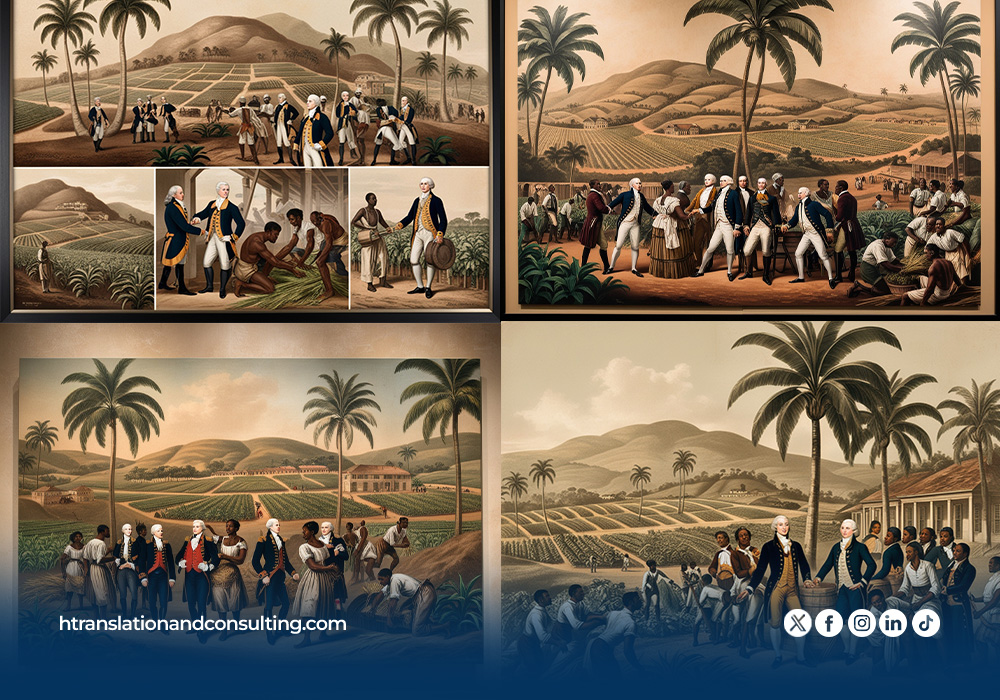
The origin of the term “Creole” lies in the colonial lexicon, derived from the Portuguese “Crioullo” and Spanish “Criollo,” themselves from the Latin “creare,” meaning “to create” or “to raise in the master’s house.” Originally, this adjective referred to Europeans born in the colonies, distinguishing them from those born in the mother country. Gradually, the term expanded to encompass various aspects of colonial reality, including slaves born in the colonies and, by extension, their language. Creole is thus historically linked to the idea of a transformation or adaptation of cultural and linguistic realities within a colonial context. It is important to emphasize the significance of colonial domination in the development of Creole linguistic structures. Haitian Creole, in particular, is the result of this dynamic of the forced reappropriation of the colonizers’ language by slaves, within a framework where their own African languages were marginalized.
The different theories on the genesis of Creole
One of the first attempts at a linguistic explanation for the formation of Haitian Creole came from Suzanne Sylvain. Her theory emphasizes the importance of African languages in the structuring of Haitian Creole, and more specifically the Ewe language. According to Sylvain, Haitian Creole is structured around an African syntax with a French lexicon. This approach, known as the substratum theory, puts forward the idea that Haitian Creole is not simply a degenerate variant of French, but a hybrid language where the African grammatical structure absorbed the vocabulary of the colonizer. This hypothesis, while innovative, remains controversial because it does not fully explain how these two distinct linguistic systems could have combined to form a new language with its own internal coherence.
In contrast, Jules Faine, in his 1937 study, proposed a superstratical approach. For him, Haitian Creole is almost entirely derived from French, specifically from the 17th-century Norman dialect. Faine adopted a more conservative position, viewing Creole as an evolving form of French rather than an entirely new language. According to this approach, African slaves simplified the French they heard, omitting complex grammatical elements to create a more accessible variant. This hypothesis overlooks the contribution of African languages to the creolization process, reducing Creole to an impoverished version of French.
However, the most debated approach remains that of relexification, notably championed by Claire Lefebvre and her team of linguists at the University of Quebec at Montreal. Drawing in part on the theories of Suzanne Sylvain, Lefebvre proposes that Haitian Creole is an African-European language in which the African syntactic structure, more specifically that of Fon, was relexified by the French lexicon. In other words, African slaves would have retained the core structures of their mother tongue, while using French words to fill in these structures. This theory, while elegant, remains criticized for its inability to account for the specific phonetic and grammatical variations that developed within Haitian Creole.
Another, more recent approach is that proposed by Robert Chaudenson, who adopts an evolutionary perspective on creolization. Chaudenson sees creolization as a process of progressive autonomization of regional varieties of French under the influence of social interactions in the colonies. He posits that Haitian Creole is a language in continuity with 17th-century regional French, influenced by the socio-historical situation of plantation society. Chaudenson argues that creolization does not result from a radical break, but from a continuous transformation, in which the slave community, particularly the bossales (slaves recently deported from Africa), played a central role in linguistic structuring by becoming the agents of socialization for the newcomers. This approach emphasizes the idea of a linguistic continuum, where Creole is a variant of French, evolving under the pressure of colonial conditions.
The uncertainty remains
However, none of these theories fully captures the complexity of the creole phenomenon. Creoles, and Haitian Creole in particular, cannot be reduced to a simple hybrid of African and European structures. As Marie-Christine Hazaël-Massieux has pointed out, creoles are entirely new languages, born from the need for communication between disparate linguistic groups. They are neither simplified forms of French nor replicas of African languages. Creolization represents a phenomenon of linguistic refounding, where lexical and phonetic elements borrowed from the source languages are reorganized to form a completely coherent linguistic system, endowed with its own grammar and phonetic rules.
The complexity of Haitian Creole is also evident in its internal structure. Unlike Indo-European languages, Haitian Creole does not adhere to the classic grammatical patterns of inflected languages. Its morphosyntax is characterized by minimal use of inflections and a rigid syntactic structure, where word order plays a crucial role. This type of linguistic reorganization is typical of creole languages, which develop in contexts of intense contact between speakers of mutually unintelligible languages. The need for immediate and effective communication leads to the simplification of complex grammatical structures, while simultaneously developing an internal coherence that allows for the stabilization of the linguistic system.
Thus, understanding the phenomenon of creolization, and more specifically the case of Haitian Creole, means recognizing the specificity of these languages, which are neither simplified derivatives nor approximate mixtures of their source languages. Haitian Creole is a language born out of the necessity to survive and communicate in an environment of domination and exclusion. It is the product of a linguistic restructuring process that drew on European and African influences while forging its own identity. Theoretical debates about its origin and development will continue to fuel linguistic discussions, but one thing is certain: Haitian Creole is a language in its own right, with its own history, its own dynamics, and its own challenges.
Conclusion
In conclusion, creolization is a rich and complex linguistic phenomenon that cannot be reduced to one-dimensional explanations. Haitian Creole, in particular, represents a fascinating example of the human capacity to create new languages in extreme contexts. The various theories that attempt to explain its genesis—whether substratic, superstratic, or evolutionary—each shed valuable light on how this language formed and evolved. However, Haitian Creole remains, above all, a living testament to the linguistic and cultural resilience of the people who forged it.
Jocelyn Godson HÉRARD, Copywriter H-Translation