


The addition of the pronoun “iel” to *Le Petit Robert* has sparked a passionate debate among linguists, public figures, and activists. Should this innovation be viewed as a step forward toward a more inclusive language, or as a rupture with the structure of French? While some languages have already integrated gender-neutral solutions, French appears caught in a tension between tradition and modernity. An analysis of a debate that is as much linguistic as it is societal.
Last October 2021, the dictionary *Le Petit Robert* incorporated the personal pronoun “iel” into its online edition, defining it as a third-person singular and plural subject pronoun used to refer to a person without specifying their gender. This decision aligns with a demand championed by non-binary individuals and activist movements advocating for linguistic inclusivity. However, this addition has sparked heated debates within linguistic, political, and media circles.
While the emergence of a new pronoun might seem innocuous, it profoundly challenges the relationship between language, society, and evolving usage. Should these innovations be embraced in the name of social progress, or should the inviolability of linguistic structures be defended instead? This controversy illustrates the constant tension between linguistic norms and societal shifts, raising questions about the role of dictionaries and the capacity of the French language to integrate new forms of expression.
The Opponents' Arguments: A Threat to Linguistic Stability?
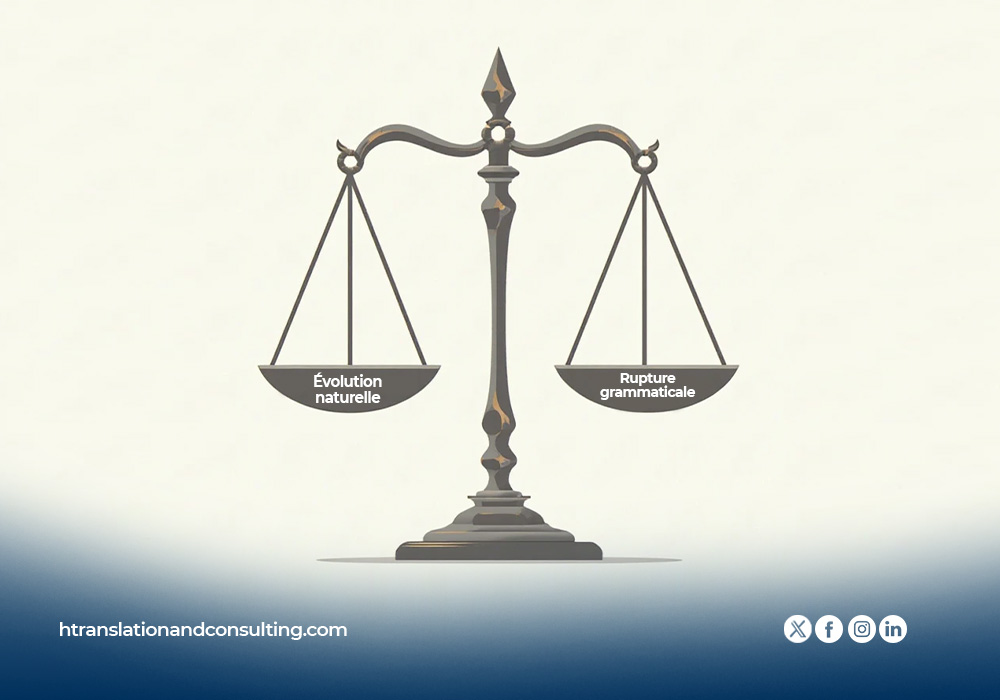
For many proponents of a conservative view of the French language, the introduction of the pronoun “iel” constitutes a challenge to the grammatical system. Bernard Cerquiglini, a linguist and lexicographer, thus points out that “pronouns have not changed since the 4th century,” and that any modification to this grammatical category would be an assault on the fundamental structures of French.
This stance is shared by several public figures, including Brigitte Macron—who believes that “the French language is so beautiful, and two pronouns are quite enough”—as well as former Minister of National Education Jean-Michel Blanquer, who maintains that “the French language is complex enough as it is; we do not need to add to it.” According to them, the introduction of new pronouns would create grammatical confusion and undermine a linguistic standard that has endured for centuries.
Jean Pruvost, another prominent figure in the field of linguistics, views this pronoun as a syntactic and ideological absurdity: “The pronoun ‘iel’ is useless and discourteous. It is an aberration. Under the guise of equality, the masculine still precedes the feminine: in ‘iel,’ ‘il’ is placed before ‘elle.’” This type of argument rests on the premise that the evolution of the French language should occur naturally and gradually, without militant or artificial intervention.
A Descriptive Role for the Dictionary: Observing Rather Than Prescribing
In the face of this criticism, Le Petit Robert justifies its decision by asserting that the mission of a dictionary is to reflect emerging usages rather than to validate or condemn them. “Defining the words that describe the world means helping to understand it better,” explains the editorial team (Robert, 2021).
This position is grounded in a descriptive approach to the lexicon: a dictionary does not create language, but rather reflects its evolutions and innovations. The use of the pronoun “iel,” while a minority practice, exists within certain communities and across specific media—particularly in activist and digital spheres. Its inclusion in *Le Petit Robert* therefore does not signify its imposition, but rather a recognition of its existence.
Marc-Olivier Loiseau, a researcher in the history of language, adopts a nuanced approach, suggesting that “this may open up the discussion on non-binary identity, just as was the case with the feminization of job titles.” The example of the feminization of professional titles indeed illustrates how social demands can influence linguistic usage and, ultimately, the official standard.
French in the Face of the Global Evolution of Languages
A Linguistic Debate with Societal Stakes
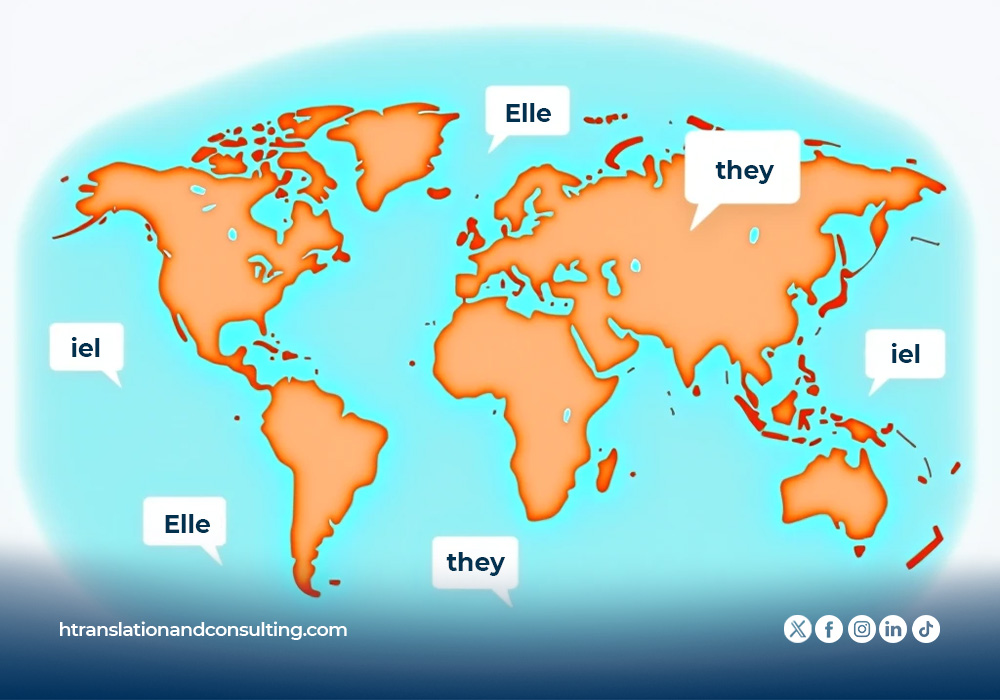
The issue of non-binary expression in language is not unique to French. In English-speaking contexts, the use of the singular *they* is now widespread to refer to a person whose gender is unspecified or does not align with traditional categories (Neveux, 2021). In Spanish, an alternative solution has been proposed involving the neutral ending *-e*, replacing the traditional gender markers *-o* and *-a*. These initiatives reflect a broader trend toward adapting languages to contemporary societal realities.
The case of French is, however, unique, insofar as its grammatical structure relies on a heavily gendered system—particularly regarding the agreement of adjectives and past participles. A fundamental question therefore remains: how should the pronoun *iel* agree with adjectives and participles? Should one say *iel est vilain* or *iel est vilaine*? The introduction of a gender-neutral pronoun thus gives rise to a series of unresolved grammatical issues, raising the question of a broader reform of the French language.
A Linguistic Debate with Societal Stakes
The controversy surrounding the pronoun “iel” extends far beyond the linguistic realm. It highlights the tensions between tradition and modernity, between stability and adaptation, and reveals language’s capacity to include or exclude certain identities. If language is a reflection of society, its evolution is inevitably influenced by cultural transformations and ideological debates.
History shows that the French language has already incorporated numerous changes driven by social usage: the feminization of job titles, the disappearance of the past simple subjunctive, and the gradual abandonment of certain agreement rules. The addition of the pronoun “iel” potentially fits within this dynamic, although its future remains uncertain.
Thus, far from being a mere lexical dispute, this question challenges our relationship with language and its role in the construction of identities. Whether or not one embraces this evolution, it illustrates the way in which a living language continues to transform over time, driven by cultural and social changes.
Jocelyn Godson HÉRARD, Copywriter H-Translation