


Insults and abuse are forms of communication characterized by brevity and intense illocutionary force. Their study allows us to explore verbal violence from a linguistic and interactional perspective, analyzing how these discursive forms emerge, function, and impact human interactions. This article proposes a socio-pragmatic approach to these particular speech acts, highlighting their communicative effectiveness and their grounding in the conflictual dynamics of discourse.
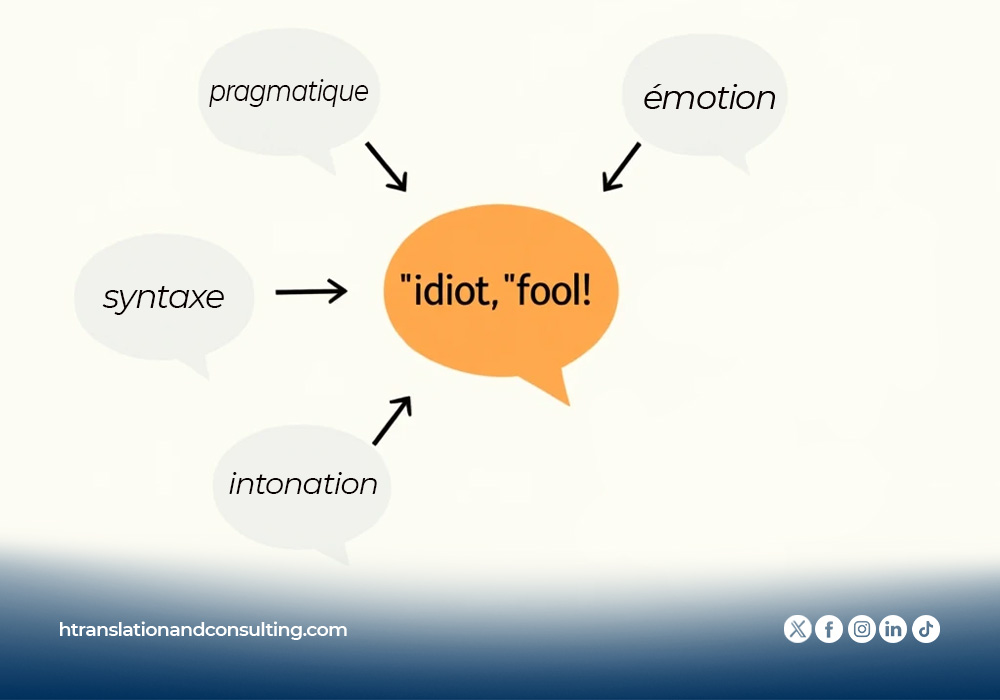
Insults and abuse, although often viewed through a social or moral lens, deserve in-depth analysis from a linguistic and pragmatic perspective. They are characterized by their brevity, their strong illocutionary force, and their occurrence within conflictual interactions. Through a socio-pragmatic and interactional approach, it is possible to understand how these discursive forms fit into a continuum of verbal violence and how they contribute to the construction of meaning in an exchange.
Verbal violence, which includes insults and abuse, is a complex phenomenon that cannot be reduced to simple linguistic aggression. Research in this area shows that it revolves around an escalation of interactional tension, marked by a series of discursive stages and triggers (Moïse, Auger, Fracchiolla, and Schultz-Romain 2008). Analysis of this escalation reveals several types of verbal violence, ranging from direct attacks to more insidious forms of linguistic aggression.
One of the fundamental characteristics of an insult is its brevity. This feature is essential to its pragmatic effectiveness: it allows for immediate recognition of its intention and maximizes its impact on the listener. This conciseness is often manifested through single-word forms, as in common insults (“idiot,” “imbecile”), or through fixed expressions, such as “you…”. This brevity is reinforced by prosodic markers, such as exclamatory intonation, which signal the intensity of the illocutionary act.
The distinction between insult and abuse rests primarily on their function and scope within the interaction. An insult, in both a legal and pragmatic sense, can take on a more structural dimension, permanently associating the targeted person with a devaluing characteristic. It thus participates in a process of essentialization, where an individual is reduced to a category or a pejorative label. An insult, on the other hand, while sharing this aim, often manifests itself in a more immediate and specific form, typical of spontaneous, conflictual exchanges.
The pragmatic analysis of insults allows us to explore their perlocutionary effects, that is, their impact on the interlocutor. As a speech act (Austin 1962), an insult is not limited to a pejorative label; it constitutes a genuine interactional issue, aiming to alter the power dynamic between speakers. An insult can thus be perceived as an attempt at verbal domination, where the speaker seeks to disqualify their interlocutor within the social space of the exchange. However, its reception varies according to contexts and prevailing social norms: the same formulation can be interpreted as a serious insult in one setting and as a joke in another.

Insults and profanity also develop within a dialogic framework, often responding to provocation or occurring within a conflictual exchange. This interactional nature explains why they can sometimes lead to verbal escalation, or even physical violence, as illustrated by certain famous examples of public disputes. Insults can thus be considered a discursive form that tests the limits of language and sociability, challenging tolerance for verbal transgressions in a given context.

Finally, insults and abuse, as brief genres, reveal a dynamic inherent to the economy of discourse. Their effectiveness lies in their ability to condense a strong axiological charge into a few words, thus placing them within a discursive tradition where the speed of message transmission is paramount. This brevity does not, however, imply a lack of complexity, as these linguistic forms often involve subtext, implicit cultural references, and effects of social categorization that require nuanced interpretation.
Thus, the study of insults and abuse, far from being limited to a simple normative or moral approach, sheds light on essential linguistic and interactional phenomena. It illustrates how language can be a tool of power and connection, and how its uses vary according to context and social norms. Their analysis therefore makes a valuable contribution to understanding the discursive mechanisms of verbal violence and the structuring of conflictual exchanges in human communication.
Bibliographical references
Austin, JL (1962). How to Do Things with Words. Paris: Seuil.
Bakhtin, M. (1977). Marxism and the Philosophy of Language. Paris: Minuit.
Fracchiolla, B., Moïse, C., Schultz-Romain, C., & Auger, N. (2013). Verbal violence . Rennes: Presses Universitaires de Rennes.
Kerbrat-Orecchioni, C. (1990). Verbal interactions (Volume 1). Paris: Armand Colin.
Kerbrat-Orecchioni, C. (2005). Discourse in interaction. Paris: Armand Colin.
Lagorgette, D. (2002). “ Insults: semantic and pragmatic approaches ”. Langue Française, 144.
Moïse, C., Auger, N., Fracchiolla, B., & Schultz-Romain, C. (2008). Verbal violence: Political and media spaces . Paris: L’Harmattan.
Perelman, C. & Olbrechts-Tyteca, L. (1988). Treatise on argumentation. Brussels: Éditions de l’Université de Bruxelles.
Plantin, C. (1996). Argumentation . Paris: Seuil.
Jocelyn Godson HÉRARD, Copywriter H-Translation