


This article traces the birth and evolution of the French language, from its Latin origins to its current status as a national and international language. By exploring the historical, cultural, and political transformations that have shaped French, it highlights the challenges and strengths of a language in constant adaptation.
The French language, as we know it today, is the product of a complex and rich history, marked by diverse linguistic, political, and cultural influences. Its origins date back to the Roman conquest of Gaul around 120 BC. At that time, the local populations spoke Celtic languages. With the Roman invasion, Latin gradually established itself as the dominant language. However, this Latin was not uniform: it split into Classical Latin, reserved for the elites, and Vulgar Latin, spoken by the lower classes. The latter, evolving through contact with local particularities and regional accents, gave rise to linguistic varieties that would lay the foundations of the future Romance languages, the ancestor of French.
In the 4th century, the fall of the Western Roman Empire and the barbarian invasions contributed to transforming the linguistic landscape. Germanic peoples, including the Franks, introduced new influences into Vulgar Latin. From this fusion emerged Romance languages, which branched out into several major regional categories: Occitan in the south, Old French in the north, and other dialects such as Breton, Flemish, and Basque.
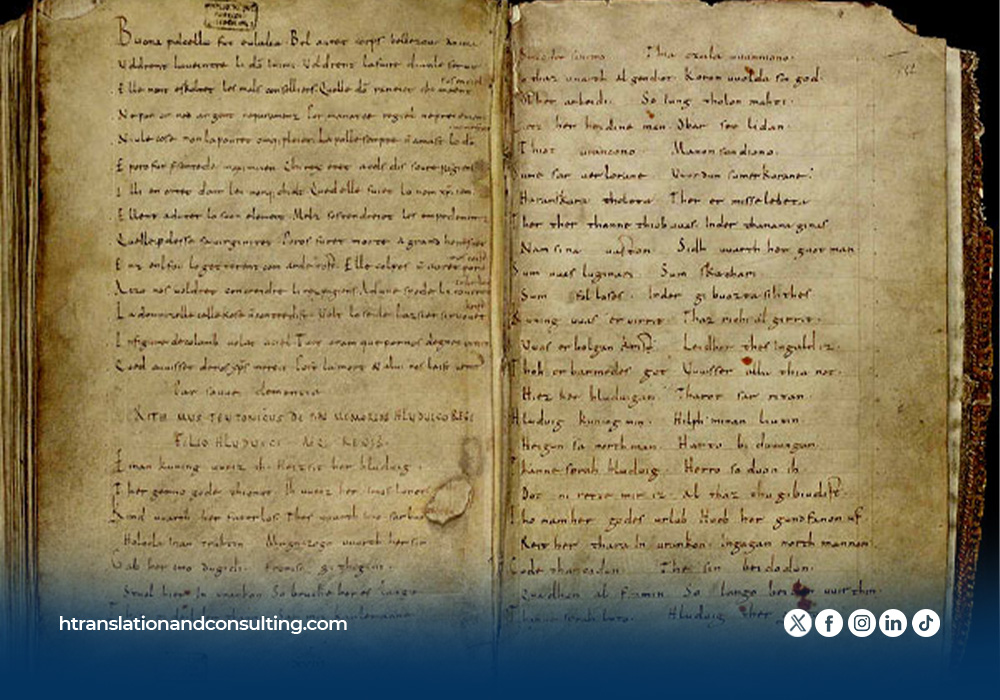
A key moment in this evolution dates to 842, with the Strasbourg Oaths. These texts, written in Romance and Germanic languages, represent the earliest known writings in a primitive form of French. Although not yet French as we understand it today, these oaths mark an important step in linguistic differentiation. A few decades later, in the 9th century, another major text, the Sequence of Saint Eulalia, testifies to an advanced stage of Old French, with linguistic characteristics closer to the modern language.
French made a significant leap toward its status as a national language in the 16th century, during the reign of Francis I. In 1539, the Ordinance of Villers-Cotterêts mandated the use of French as the official language in all administrative and judicial acts of the kingdom, gradually replacing Latin in these functions. This decision, although motivated more by political and administrative considerations than linguistic ones, was decisive in standardizing and establishing French as the language of power.
However, at that time, a large majority of the population continued to speak regional dialects, while French remained the language of the court and the elite. This linguistic divide began to narrow in the 17th century, notably thanks to the founding of the French Academy in 1635 by Cardinal Richelieu. This institution, composed of writers and intellectuals known as “immortals,” was tasked with standardizing the language by developing a grammar and a dictionary. Classical French, thus codified, became a standard, although it still remained somewhat removed from everyday usage.

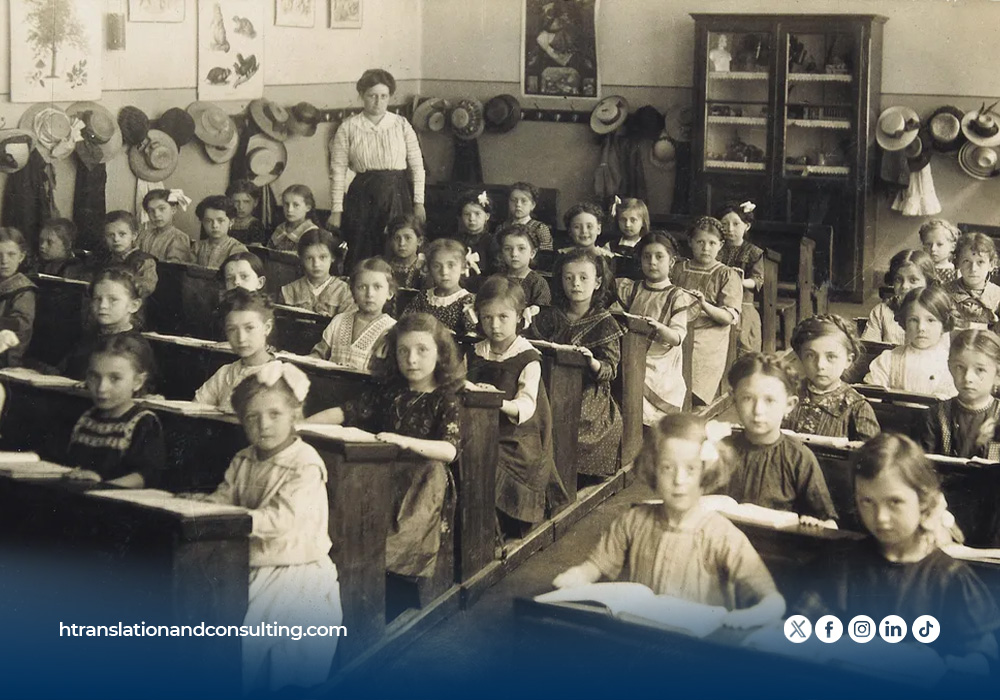
The real turning point in the spread of French across all social classes came in the 19th century with Jules Ferry’s educational reforms. From 1880 onward, free, compulsory, and secular schooling mandated instruction in French, relegating regional dialects to a secondary status. This period marks the birth of modern French, disseminated uniformly throughout the country. The rise of media in the 20th century, such as radio and television, further reinforced this linguistic homogenization by standardizing vocabulary and pronunciation.
However, despite this progress towards a common language, French did not escape external influences. Over time, it became richer, but also eroded under the effect of massive borrowings from English, particularly in the technological and cultural spheres. This evolution raises questions about preserving the richness and specificity of French in the face of globalization.
In conclusion, the French language is the product of a long history of cultural exchange and adaptation. From its Latin origins to its modern standardization, it has established itself as a powerful vehicle for cultural and national identity, while remaining open to external influences. Its preservation and adaptation to contemporary realities represent a challenge, but also an opportunity to celebrate its diversity and vitality.
Bibliographical references
Thaloe.free.fr. Birth of the French language.
Alloprof.qc.ca. The birth and development of the French language.
Fr.babbel.com. The origins of the French language
1jour1actu.com. How the French language was born.
Jocelyn Godson HÉRARD, Copywriter H-Translation