


This article is an in-depth reformulation of the text « Le langage est-il le propre de l’homme ? » by Cédric Sueur (2023), exploring the specificities of human language and its similarities with animal communication. Through the perspectives of linguistics, philosophy, and ethology, it examines the communicative abilities of primates, dolphins, and birds to better understand where the boundary between language and communication lies.
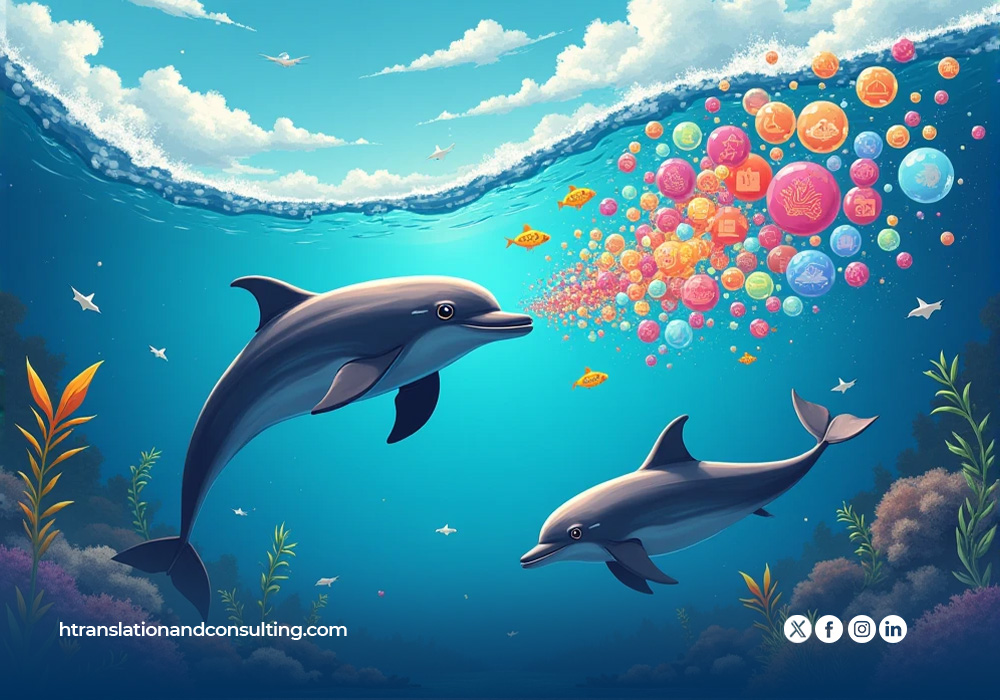
Language has long been considered a characteristic unique to humanity. From Aristotle to contemporary theorists, it is often described as what distinguishes humans from animals, allowing them to articulate complex thoughts, develop abstract concepts, and transmit knowledge across generations. However, this traditional view is increasingly being challenged in light of research in ethology, linguistics, and neuroscience. Communication in the animal kingdom reveals sophisticated systems, sometimes endowed with complex syntactic and semantic structures, inviting a reconsideration of the boundary between human language and animal communication.
Human language is characterized by several distinctive traits, notably the double articulation of language, syntactic creativity, and the ability to refer to absent objects or events. Martinet (1960) defines double articulation as the ability to combine meaningless minimal units (phonemes) into larger meaningful units (morphemes), and then to organize these morphemes into coherent syntactic structures. This characteristic allows human language an unparalleled flexibility and richness in the animal kingdom. Furthermore, according to Chomsky (1965), human syntax is based on generative rules allowing the formation of an infinite number of utterances from a limited set of elements.
However, the idea that only the human species is capable of such linguistic feats is now nuanced by numerous observations in ethology. Some non-human primates, such as chimpanzees and bonobos, have demonstrated an ability to learn symbolic languages, such as sign language or lexigrams (Savage-Rumbaugh et al., 1986). Washoe, a chimpanzee raised in a human environment, learned to use several hundred signs from American Sign Language (Fouts, 1973). Similarly, Koko, a gorilla, showed an ability to combine signs to express emotional states and specific requests (Patterson & Gordon, 2001).
Beyond primates, other species reveal elaborate forms of communication. Dolphins, for example, use a system of complex vocalizations, including individual-specific whistles, similar to proper names (Janik & Slater, 1997). Studies have also shown that certain birds, such as zebra finches, are capable of acquiring syntactic structures by combining sound patterns according to precise rules (Gentner et al., 2006).
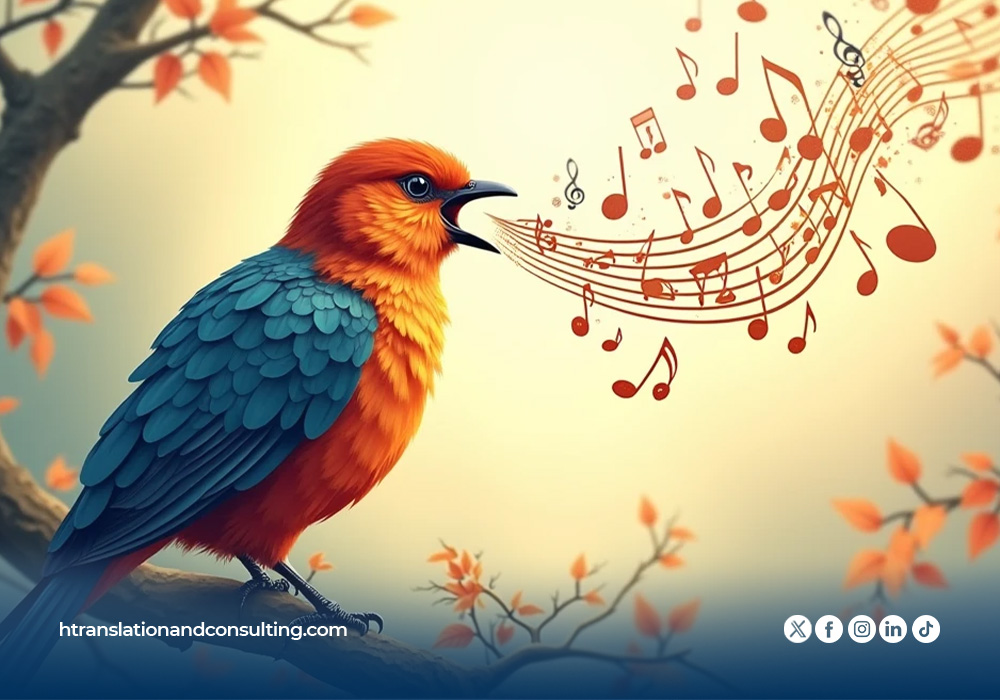
However, despite these similarities, animal communication differs from human language in several ways. First, the ability to express abstract concepts seems limited in animals. While some primates can use symbols to designate objects or actions, there is no evidence that they can discuss concepts as abstract as philosophy, politics, or religion, as human language allows (Hauser, Chomsky & Fitch, 2002). Second, animal communication is generally anchored in the present moment: it signals dangers, food resources, or immediate behavioral intentions, but does not seem to allow for flexible explicit reference to the past or the future (Clayton et al., 2001).
Another point of divergence concerns the cultural transmission of language. In humans, language is learned within communities and evolves over time through social and historical processes. Diachronic linguistics shows that human languages are subject to phonetic, morphological, and syntactic changes that reflect the evolution of societies (Labov, 1994). In contrast, although some animal species, such as cetaceans or songbirds, possess socially transmitted regional dialects, these communication systems remain more rigid and do not reach the complexity of human languages (Marler, 2004).
The study of animal language also raises methodological and epistemological questions. Anthropomorphism—the tendency to attribute human cognitive and linguistic abilities to animals—can bias the interpretation of experimental results (Sueur, 2022). It is essential to adopt a rigorous approach to distinguish what constitutes a true linguistic capacity from what might be the result of conditioning or excessive human interpretation of animal behavior.
Finally, zoosemiotics, which studies animal communication systems in their ecological and social context, provides complementary insight into these phenomena (Guillaume, 2021). Rather than seeking to determine whether animals possess a « language » in the strict sense, this approach invites an understanding of animal communication within its own logic, respecting its biological and cognitive specificities.
In conclusion, while human language retains unique characteristics, notably its generative syntax and its capacity to express abstract ideas, animal communication reveals structures far more complex than previously thought. Rather than rigidly opposing human language and animal communication, it seems more relevant to adopt a gradual perspective, where certain species develop forms of communication sharing properties with human language, without however reaching its level of complexity and flexibility. This research not only sheds light on our understanding of the evolution of language but also questions our relationship with the animal world and its modes of expression.
Jocelyn Godson HÉRARD, Copywriter H-Translation