


Creolization, a complex process of linguistic and social interaction, shapes creole languages in contexts of prolonged contact between different populations. This article explores theories of creolization and the mechanisms of language acquisition that allow creoles to develop as autonomous linguistic systems. By analyzing specific cases from the Caribbean and the Indian Ocean, it highlights the central role of social dynamics and historical influences in the formation and evolution of these languages.
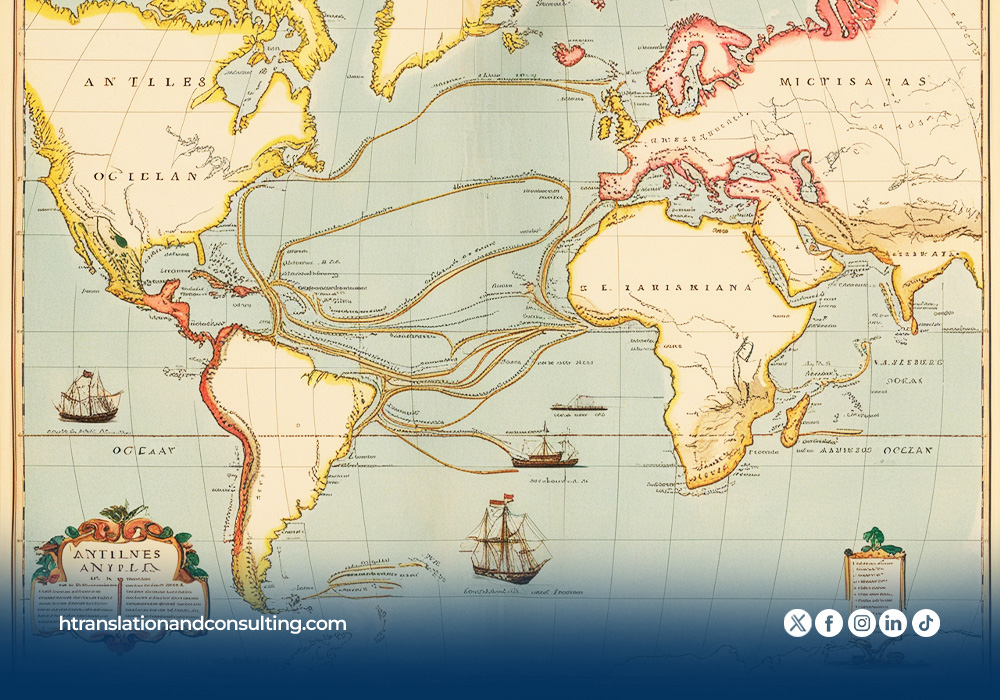
Creolization is a complex process involving the gradual transformation of several languages into a new linguistic form, often in contexts of prolonged contact between populations of diverse linguistic origins. Understanding this phenomenon requires not only an analysis of the social dynamics surrounding it, but also an in-depth study of how languages are transformed under the influence of the various actors involved in this contact. The language acquisition process also plays a central role in how creoles form and stabilize over time.
This article examines several major contributions to the field, stemming from discussions and research held during a roundtable that explored the intersections between creolization and language acquisition. This multidisciplinary framework allows for a better understanding of the different stages leading to the stabilization of a creole language and the factors that influence this process. Robert Chaudenson’s theory of creolization, widely accepted in this field, serves as a guiding thread for many of the studies presented here. It highlights the importance of the social environment in the formation of creole languages, particularly through the role of imperfect linguistic models adopted by contacting populations.
First, it is essential to examine the historical and social context in which these languages emerged. Creoles often developed in colonial societies characterized by significant social inequality, where slaves and European colonists interacted within a framework of domination. In these contexts, the slaves’ acquisition of European languages was often imprecise, frequently lacking formal transmission, leading to a gradual transformation of the languages present. This dynamic, which Chaudenson describes as the “autonomization” of creoles from their source languages, is the result of a process of adaptation to specific communication conditions.
A particularly insightful study presented in this collection is that of G. Hazaël-Massieux, which focuses on the French Antilles during the colonial period. It challenges Bickerton’s theory that creolization is triggered by a deficient linguistic input in children. The author demonstrates, on the contrary, that in many cases, slaves were intensively exposed to French language and culture, notably through religious education and contact with the children of colonists. This level of acculturation makes the idea of a “linguistic deficit” at the origin of creoles unlikely, even if gaps in language transmission may have appeared at later times, particularly during the expansion of plantations.
These discussions reveal the importance of social structure in the formation of creoles, while also highlighting the complexities inherent in the language acquisition process in contact contexts. The analyses presented here go beyond a simple description of linguistic phenomena; they seek to understand the profound interactions between social dynamics and linguistic transformations. This theoretical framework is particularly relevant when exploring the different stages of language acquisition by creole-speaking communities.
The importance of the social and economic conditions in which Creole-speaking communities find themselves cannot be underestimated when explaining the formation of Creole languages. The model of colonial society, particularly that of the French Antilles, provides a relevant framework for understanding how these languages developed. In the early phases of colonization, enslaved people were often acculturated, not only through the daily use of French, but also through the imposition of cultural and religious norms. This process, while aimed at assimilation, played a paradoxical role in the creation of an autonomous linguistic space: Creole.
Dominique Fattier’s study sheds valuable light on how these processes took root in Saint-Domingue society. The *Manuel des habitants de Saint-Domingue*, published in 1802, shows how colonists sought to communicate with the local Black population by developing a creole language that incorporated elements of 17th-century vernacular French. Fattier emphasizes that this variety of creole closely resembled regional forms of French from the period, but was also influenced by the diverse languages spoken by the recently arrived African slaves. This reveals the complexity of the creolization process, which was not simply a copy of a dominant language, but a dynamic interplay of multiple linguistic and cultural influences.
This interaction becomes even more evident when considering how creoles have evolved over time, not only through external linguistic influences but also due to the internal dynamics of colonial societies. André Valli, in his analysis of Réunion Creole, demonstrates that certain grammatical features of this creole are in fact survivals of older forms of French, rather than innovations resulting from creolization. He shows that the use of the zero determiner, for example, was present in 15th- and 16th-century French and was simply perpetuated in Réunion Creole. This observation challenges the idea that all creole characteristics result from simplification or a process of rupture with the lexical language.
These studies highlight a central point: creolization is not a uniform process of degradation of a “pure” language, but rather a linguistic evolution influenced by both external factors (such as exposure to different languages) and internal factors (such as the grammatical dynamics specific to the source language). In this sense, Réunion Creole, like other creoles, embodies a mixture of influences that have been adapted and transformed to meet the specific communicative needs of the populations concerned.
Dany Adone continues this line of thought in his study on the acquisition of preverbal markers in Mauritian children. His work confirms the hypothesis that certain temporal and aspectual distinctions are acquired very early by Creole-speaking children, notably the distinction between states and processes, an essential component of the linguistic bioprogram. Although his data do not fully confirm all the predictions of Derek Bickerton’s Bioprogram Hypothesis, they nevertheless highlight that certain grammatical features of Creoles are acquired rapidly, which could indicate that these distinctions are deeply rooted in the grammar of these languages.
The study of Creole language acquisition, particularly in informal learning contexts, raises important questions about the role of native speakers in language transmission. Bernard Py proposes an innovative approach, combining the analysis of learners’ utterances in real-life communicative situations with the study of broader “interactional sequences,” which include communicative strategies based on interactive knowledge. This approach allows us to explore how learners gradually adjust their interlanguage based on the linguistic information they receive from native speakers, and how these interactions shape their language acquisition.
This dynamic is particularly interesting in creolization contexts, where learners—often slaves or subordinate populations—were required to interact with speakers of approximate or evolving languages, rather than with speakers of the lexifier language in its “pure” form. This led to the formation of creoles as autonomous languages, resulting from the failure or absence of a “didactic contract” between native speakers and learners. This concept of a didactic contract, applied to creolization, allows for a better understanding of how creoles evolved as independent linguistic systems.
Daniel Véronique, for his part, addresses the question of the syntactic structuring of utterances in French learners. His research shows that the acquisition of a new language does not necessarily follow a linear trajectory from parataxis to complex syntax. Some learners organize their utterances pragmatically from the outset, focusing on thematic or rhematic constructions, which leads them to use structures similar to those found in certain French creoles. This observation suggests that creolization, like language acquisition, can be influenced by common cognitive mechanisms.
Finally, Robert Chaudenson’s analysis of language acquisition in a colonial context makes an essential contribution to this discussion. He shows that creolization results not only from exposure to approximate varieties of the lexical language, but also from a broader process of linguistic appropriation within specific social conditions. Comparisons between different varieties of colonial French, whether spoken in Louisiana, Réunion Island, or Haiti, reveal commonalities that allow for a better understanding of the mechanisms of evolution in these languages. Chaudenson emphasizes that the characteristics of creoles cannot be attributed solely to external influences or acquisition errors, but rather reflect a more complex process of linguistic restructuring and adaptation.
The study of creolization, as presented by Albert Valdman, focuses on exploring the dynamics of creole transformation over time, particularly through the concept of decreolization. Valdman demonstrates that the Creole of Saint-Domingue, the precursor to Haitian Creole, initially exhibited more pronounced structural similarities with French than are observed in contemporary Haitian Creole. This observation challenges the traditional model of decreolization, according to which creoles gradually evolve toward forms closer to the lexifier language through prolonged contact. On the contrary, Valdman proposes that even in its earliest stages, the Creole of Saint-Domingue already possessed internal diversity, with variations ranging from the basilect to forms closer to vernacular French, thus constituting a kind of linguistic continuum.
This phenomenon of internal variation within creoles is a central aspect of their development, and Valdman proposes the hypothesis of a “repidginization” that occurred with the massive arrival of new African slaves, the Bossals. These latter, by learning the creole already in use in the colony, would have introduced a second wave of linguistic restructuring, thus reinforcing the differences between creole and French. This hypothesis aligns with Chaudenson’s theory, which posits that creolization is largely the result of the progressive approximation of the lexical language by successive speakers, each making their own adjustments and transformations.
The concept of repidginization offers an interesting explanatory framework for understanding why certain linguistic features of creoles seem to diverge further from the original language over time, rather than converge with it. This phenomenon can be seen not as simple linguistic degeneration, but rather as an adaptive process, where each generation of speakers adjusts the language according to the communicative needs and social constraints it faces. This perspective challenges the classical view of linear decreolization and invites us to consider creoles as constantly evolving languages, shaped by complex dynamics of linguistic contact and adaptation.
In his study of how creole languages gain autonomy from their source languages, Gabriel Manessy highlights the importance of the role of approximate varieties of French in colonial societies. By observing the linguistic situation in Francophone Africa, Manessy draws a parallel between the creolization processes observed in the Caribbean colonies and those at work in postcolonial African societies. In these contexts, Francophone populations are exposed to an approximate form of French, transmitted by a local elite whose command of standard French is often imperfect. This linguistic approximation, supported by a partial awareness of academic norms, creates a space conducive to the reinterpretation and adaptation of grammatical and lexical structures, leading to a form of progressive creolization.
This phenomenon is particularly evident in the emergence of African creoles, which, despite prolonged contact with standard French, develop their own linguistic features, often influenced by local languages. This comparison allows for a better understanding of the mechanisms at work in the formation of creoles in classic colonial societies, where enslaved Africans learned a rudimentary version of French, transmitted by other enslaved people or already acculturated creoles. Manessy emphasizes that this process of linguistic autonomy is a key element of creolization, as it allows creoles to develop as independent languages, with their own grammatical rules and their own systems of meaning.
From a similar perspective, Catherine Miller examines the varieties of Arabic spoken in Sudan, notably Ki-Nubi and Juba Arabic, which exhibit marked creole characteristics. These varieties, spoken by non-Arabic-speaking populations, have undergone profound phonological and grammatical restructuring, thus diverging from standard Arabic dialects. Miller shows that these creolized languages have developed a more systematic correspondence between form and meaning, as well as a widespread use of analytic constructions. This process of linguistic empowerment reflects dynamics similar to those observed in the creolization of European languages in a colonial context, and raises the question of whether these languages should be considered true creoles or heavily restructured dialectal varieties.
The contributions presented in this article highlight the richness and complexity of creolization processes, emphasizing the importance of the social, historical, and linguistic contexts in which these languages developed. What emerges from these studies is that creolization is not a straightforward or simplistic process, but rather a multidimensional phenomenon influenced by complex internal and external dynamics. Far from being mere approximations of their source languages, creoles are autonomous languages that develop along their own trajectories, responding to the communicative needs and social constraints of the communities that speak them.
The question of creole acquisition and intergenerational transmission is a central aspect of creolization research. The work presented here shows that children’s creole acquisition often follows trajectories similar to those observed in first language acquisition, with aspectual and temporal distinctions appearing very early. This confirms the hypothesis that creoles reflect universal cognitive processes of linguistic structuring, while also incorporating specific elements linked to the social and historical conditions in which these languages emerged.
One of the key findings of this research is the interconnectedness of creolization and language acquisition in contexts of prolonged contact. Indeed, creolization processes are inextricably linked to how individuals, particularly children, acquire and reinterpret the languages around them. The cognitive approach to language acquisition applied to creoles suggests that these languages develop not as degraded systems, but as natural languages, responding to the same structural imperatives as any other language. The aspectual, temporal, and semantic distinctions that appear early in young children’s creole acquisition illustrate just how complete and autonomous these languages are.
From this perspective, theories that view creolization as a simple process of linguistic simplification, or a sign of cognitive breakdown, must be revised. The contributions presented in this article demonstrate that creolization, on the contrary, involves a high degree of linguistic creativity, fueled by complex interactions between languages in contact. The fact that these processes are often observed in contexts of colonial domination and social oppression should not obscure the intrinsic richness of creole languages. Far from representing impoverished or corrupted forms of their lexifiers, these languages reflect profound sociolinguistic dynamics, which include both adaptation to contexts of unequal contact and linguistic innovation.
Studies by Robert Chaudenson, Albert Valdman, and other researchers have also highlighted the crucial role of social context in the formation and evolution of creoles. Chaudenson, for example, emphasizes the importance of plantation and settlement societies in the early stages of creolization. These societies, where enslaved people were often in contact with vernacular and approximate forms of French, served as a crucible for the development of creoles. This social dimension should not be overlooked in the analysis of creole languages, as it sheds light on how these languages became autonomous from their lexifiers, integrating elements from African languages and transforming structures inherited from French.
The dynamic aspect of creolization is also highlighted by Valdman, who shows that internal variation within creoles is present from the earliest stages of their development. This variation, which he associates with phenomena of repidginization, underscores the fluid and evolving nature of creoles, which continue to transform even after their emergence. This process is also illustrated by the acquisition of creoles by new groups of speakers, notably the Bossals in the case of Saint-Domingue, who learned and modified the existing creole by introducing elements from their own native languages. This phenomenon of continuous hybridization shows that creoles are never static, but rather in perpetual transformation.
Far from being peripheral or marginal languages, creoles bear witness to the resilience and creativity of colonial and postcolonial communities. They are the product of a complex history of domination, oppression, and resistance, but also of linguistic and cultural innovation. Understanding creolization and creole acquisition invites us to reconsider our traditional conceptions of linguistic change and to recognize the intrinsic value of these languages. Creoles, as fully developed languages, constitute a rich field of study for linguists, but also for anthropologists, historians, and sociologists, because they embody a unique form of human adaptation to specific historical contexts.
Jocelyn Godson HÉRARD, Copywriter H-Translation