


A groundbreaking longitudinal study by Noyer-Martin and Baldy reveals the intricacies of writing acquisition in young children. By following four cohorts over three years, the researchers highlighted the various strategies adopted by the children, from initial confusion between drawing and writing to mastery of spelling rules. This research underscores the importance of an individualized approach to writing instruction and offers valuable insights for the early identification and prevention of learning difficulties. A fascinating exploration of the complex mechanisms underlying the emergence of this fundamental skill.
At age four, there is a wide diversity in the strategies children use. Some continue with a pictorial approach, while others begin to adopt a more linear style of writing or produce letters unrelated to phonology. This heterogeneity in performance at age four suggests that it is a pivotal age in the acquisition of writing, marked by significant inter-individual variations.
Around age 5, a significant development is observed. The majority of children now produce letters, even if these do not yet correspond to the sounds of spoken language. This stage marks an important step forward in understanding the symbolic nature of writing. However, the study reveals that some children continue to use pictorial strategies at this age, which could be an indicator of future difficulties in learning to write.
The introduction of formal writing instruction, which typically begins at age 6 with the first year of primary school, marks a significant turning point. Most children of this age begin to establish correspondences between phonemes and graphemes, demonstrating an understanding of the alphabetic principle. However, the study highlights that some children continue to write letters unrelated to phonology, suggesting potential difficulties in acquiring the alphabetic system.
At age 7, we observe a growing mastery not only of phoneme-grapheme relationships, but also of basic spelling rules. This progress demonstrates the impact of formal education and the cognitive maturation of children.

At age four, there is a wide diversity in the strategies children use. Some continue with a pictorial approach, while others begin to adopt a more linear style of writing or produce letters unrelated to phonology. This heterogeneity in performance at age four suggests that it is a pivotal age in the acquisition of writing, marked by significant inter-individual variations.
Around age 5, a significant development is observed. The majority of children now produce letters, even if these do not yet correspond to the sounds of spoken language. This stage marks an important step forward in understanding the symbolic nature of writing. However, the study reveals that some children continue to use pictorial strategies at this age, which could be an indicator of future difficulties in learning to write.
The introduction of formal writing instruction, which typically begins at age 6 with the first year of primary school, marks a significant turning point. Most children of this age begin to establish correspondences between phonemes and graphemes, demonstrating an understanding of the alphabetic principle. However, the study highlights that some children continue to write letters unrelated to phonology, suggesting potential difficulties in acquiring the alphabetic system.
At age 7, we observe a growing mastery not only of phoneme-grapheme relationships, but also of basic spelling rules. This progress demonstrates the impact of formal education and the cognitive maturation of children.
Qualitative analysis of individual trajectories reveals two types of changes in the evolution of writing strategies. On the one hand, we observe shifts in strategy, where the child adopts a radically different approach from one year to the next. On the other hand, we note continuous improvements within the same strategy. These observations suggest a dynamic developmental process, where the child’s knowledge evolves in interaction with external constraints, leading to the emergence of new strategies when previous ones reach their limits.
A particularly interesting aspect of this study is the identification of atypical developmental trajectories. The authors observed that children who persisted in using the pictorial strategy at ages 4 and 5 were more likely to experience difficulties in establishing phoneme-grapheme correspondences at age 6. This observation underscores the importance of early intervention to help these children overcome the hurdle of distinguishing between drawing and writing.
Similarly, the study highlights the importance of motor skills in the acquisition of writing. Children who had not sufficiently practiced letter formation before the age of six (for example, remaining exclusively focused on spatial strategies) were more likely to experience motor difficulties with writing later in life. These results corroborate the work of Graham and colleagues on the importance of early motor training in preventing writing difficulties.
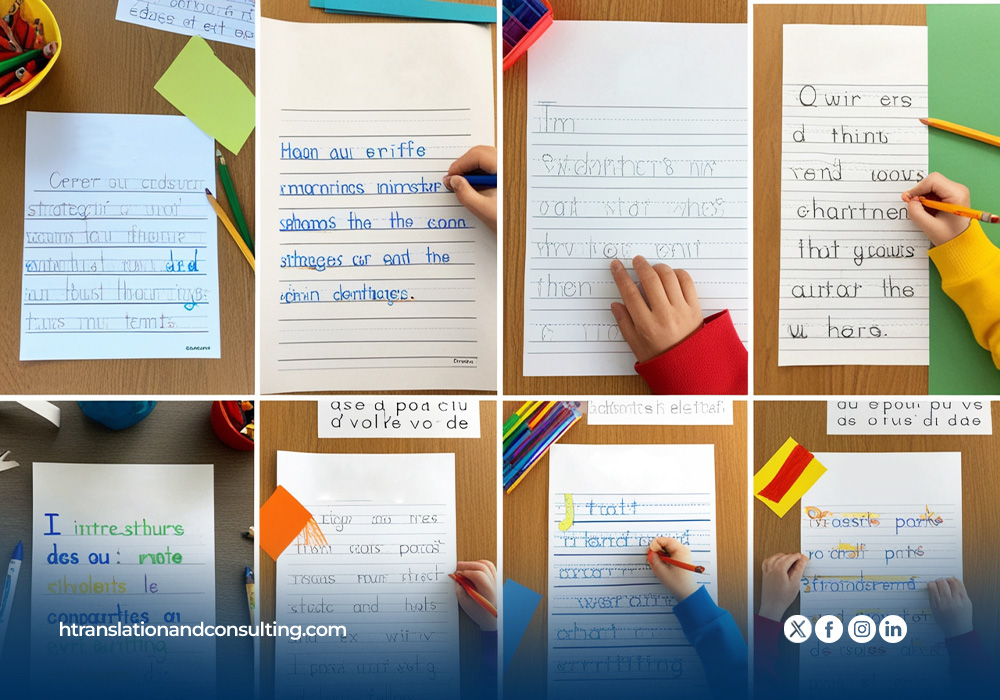
In conclusion, this study provides valuable insights into the developmental trajectories of writing acquisition in young children. It underscores the importance of an individualized approach to writing instruction, taking into account the wide variability in developmental pace. The authors suggest that early identification of children who persist with less advanced strategies could allow for targeted interventions to prevent later difficulties.
This research also opens up interesting avenues for future studies. It would be worthwhile to explore in greater detail the factors that influence individual trajectories, such as the family environment, teaching practices, and children’s cognitive characteristics. Furthermore, a more nuanced analysis of the transitions between different strategies could provide valuable insights into the mechanisms underlying the acquisition of writing skills.
Finally, the pedagogical implications of this study are numerous. It underscores the importance of a differentiated approach to writing instruction, adapted to each child’s strategies and pace of development. It also encourages teachers to be attentive to early signs of potential difficulties, thus enabling rapid and targeted intervention. In a context where literacy is crucial for academic success and social integration, these results provide a solid foundation for improving teaching practices and supporting all children in their writing development.
Jocelyn Godson HÉRARD, Copywriter H-Translation