


In this article, we delve into Noam Chomsky’s fundamental distinction between linguistic competence and performance. Competence, representing the implicit knowledge of grammatical rules, is contrasted with performance, which refers to the concrete use of language in real-world situations. We will also explore the notion of linguistic universals and the quest for a universal grammar, while examining the challenges and limitations of these concepts in modern linguistics.
Linguistic competence and verbal performance are central concepts in modern linguistics, particularly within the framework of Noam Chomsky’s generative theory. These two notions are fundamentally distinguished by their role and function in language use. Competence refers to speakers’ internal and implicit knowledge of linguistic rules, while performance designates the concrete application of this competence in real-life communication situations.
From his earliest reflections, Chomsky considered the relationship between the generative model he was developing and speakers’ actual use of language. Even before formally introducing the terms “competence” and “performance,” he had already laid the groundwork for this distinction by emphasizing the theoretical nature of grammatical structure. In his work “Syntactic Structures,” he mentions that the grammar he proposes is only a theoretical model, while suggesting that it could help illuminate the process of understanding sentences in real language. However, he acknowledges that understanding a sentence requires knowledge beyond purely linguistic knowledge, particularly regarding meaning and reference.
Chomsky thus initially demonstrated a degree of caution regarding the explanatory power of his grammatical model. He acknowledged that speakers’ language performance could not be explained solely by the linguistic levels he described. This position would evolve, particularly under the influence of the writings of Wilhelm von Humboldt, who argued that the form of language could not be reduced to a conceptual abstraction, but that it also expressed how a human community structures its ideas and perceptions through language.
Inspired by this concept, Chomsky gradually reinforced the idea that studying the generative processes underlying competence is a necessary condition for understanding language use. He went so far as to assert that the only way to seriously address questions of verbal performance is to rely on a generative theory of competence. Thus, according to Chomsky, studies of performance that do not take into account the generative mechanisms underlying competence risk being incomplete. He posits that the generative model is the primary tool for studying performance, and that it is thanks to this model that the most relevant results in this field have been obtained.
The distinction between competence and performance thus rests on a fundamental asymmetry: while competence is a system of abstract and intangible rules, performance is the actualization of this competence in concrete communication situations. However, performance does not always accurately reflect an individual’s competence. It can be influenced by a range of internal factors, such as memory limitations, production errors, or perceptual interference. It can also be affected by external factors, such as the context of the interaction, the intentions of the interlocutors, or environmental conditions.
Competence, on the other hand, is a perfect theoretical knowledge. It manifests itself through a set of rules that govern the deep structure of language and allow the speaker to produce and understand an infinite number of sentences. From this perspective, the linguist’s main task is to model this competence, focusing on the mental structures underlying sentence production and comprehension. Errors, hesitations, or reformulations that appear in actual performance are not central to linguistic analysis, as they stem from psychological or contextual aspects that the generative model does not directly attempt to explain.
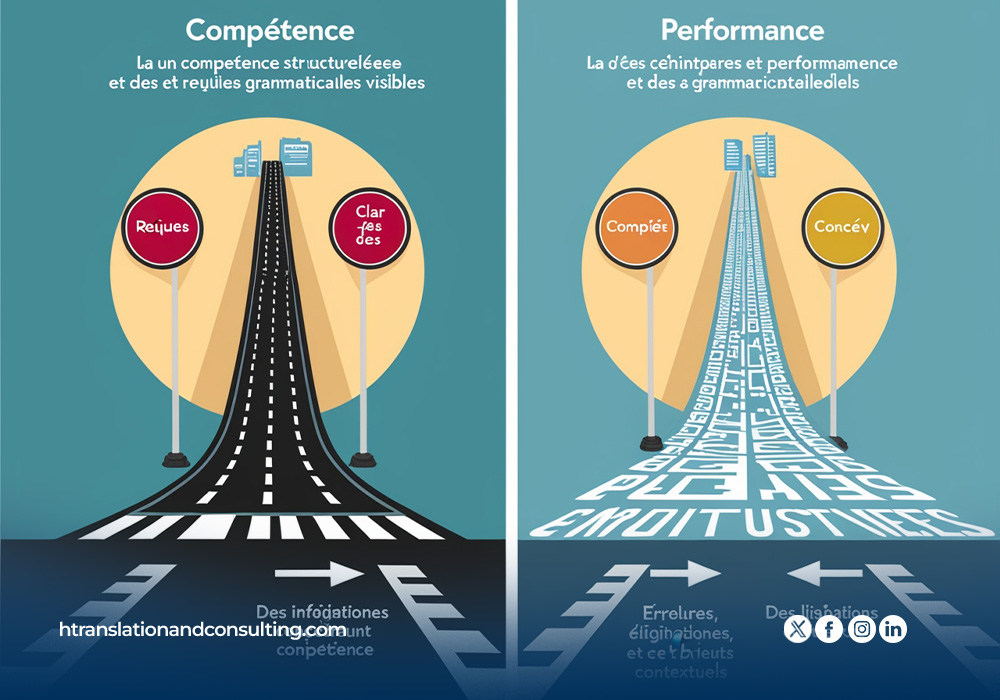
This conception was adopted by all linguists of the generative school, who continued to assert the primacy of competence over performance. The linguist must describe the mental reality underlying language acts, while psycholinguistics is dedicated to the study of the psychological conditions and cognitive processes that affect performance. The theory of competence is constructed autonomously, whereas the theory of performance must necessarily integrate elements of competence to be valid.
After the publication of *Aspects of Syntactic Theory*, Chomsky further reinforced the distinction between competence and performance, to the point of suggesting that performance lacks its own autonomy. Although he never explicitly stated this idea, it is evident in several of his writings, where he discussed the inadequacy of competence models to directly explain performance. He admitted that transposing a generative model designed to describe competence into the realm of performance would be a mistake. Yet, it is difficult not to perceive in his work a constant tension between these two domains, which has sometimes led to confusion in their respective boundaries.
Alongside this reflection on competence and performance, Chomsky developed the idea that linguistic competence rests on universal principles common to all languages. These linguistic universals constitute the basis of what he calls “universal grammar,” a set of innate structures that underlie all human languages, despite their superficial differences. The goal of generative theory is to model these universal structures and formulate rules applicable to all languages.
However, this quest for a universal grammar raises several challenges. The first concerns the extent of universal features. Chomsky never gave a definitive answer to the question of whether all the rules of generative grammar are universal, or only some of them. He suggests that fundamental principles, such as the distinction between deep and shallow structure, belong to universal grammar, but at other times he implies that all the rules of grammar could be universal.
The second challenge is methodological. Generative grammar models have been primarily developed using English and Indo-European languages. However, comparative studies of non-Indo-European languages have shown that some of the categories used in these models do not apply to all languages. This calls into question the universality of the structures described and underscores the need for research on a wider range of languages to validate these theories.

Finally, another essential question raised by Chomsky concerns the relationship between linguistic universals and cognitive or perceptual universals. Some psychological theories suggest that many principles at work in language are also present in other aspects of human behavior, which could challenge the specificity of universal linguistic structures. Chomsky acknowledges that language shares certain characteristics with other cognitive systems, such as intentionality or syntactic structure, but he argues that the specificity of language lies in its creativity. This creativity, according to him, fundamentally distinguishes human language from other forms of communication and other cognitive behaviors.
In conclusion, the distinction between competence and performance, as well as the idea of a universal grammar, constitute pillars of Chomsky’s linguistic theory. While competence is an abstract system of mental rules, performance is the concrete expression of this knowledge in real-world situations, influenced by numerous factors. Linguistic universals, for their part, remain a central concept but one that is difficult to validate exhaustively, due to the diversity of natural languages and the resulting methodological constraints. These reflections continue to generate debate, both in the fields of linguistics and cognitive psychology.
Jocelyn Godson HÉRARD, Copywriter H-Translation