


This article—a summary of the article entitled “The Relationship Between Semantic and Phonic Change in Michel Bréal”—explores the complex interactions between semantic and phonetic changes in language evolution. By analyzing how words evolve in both pronunciation and meaning, it highlights the linguistic dynamics and the social, cultural, and historical factors that influence these transformations. Through examples and a theoretical perspective, the study proposes an integrated approach to linguistic phenomena to better understand the processes of language adaptation and transformation.
The study of linguistics is distinguished by its ability to illuminate the subtle and gradual transformations of languages throughout history. One of the central focuses of this exploration lies in understanding semantic and phonetic changes, two deeply interconnected phenomena that illustrate the plasticity of linguistic systems and their responsiveness to the evolving needs of speakers. This article explores the complex interrelationships between these two types of change, while examining specific case studies to illustrate the observed phenomena.
The definition of the concepts of semantic and phonetic change
Semantic change refers to the modifications in meaning that words or expressions in a language undergo over time. This process results from various factors, such as cultural evolution, interlinguistic contact, and social transformations. Words change in meaning, connotation, and even grammatical function. A word’s lexical field can thus be expanded or, conversely, restricted. These changes are not random; they often follow patterns linked to the shared experience of speakers or to cultural and technological innovations.
In parallel, phonetic change refers to alterations in the pronunciation of a language’s sounds. It can affect vowels, consonants, or diphthongs, through various processes such as articulatory simplification, assimilation, dissimilation, or vowel reduction. Phonetic changes play a crucial role in language evolution, sometimes leading to dialectal divergences or the emergence of new languages.
The links between semantic and phonetic change
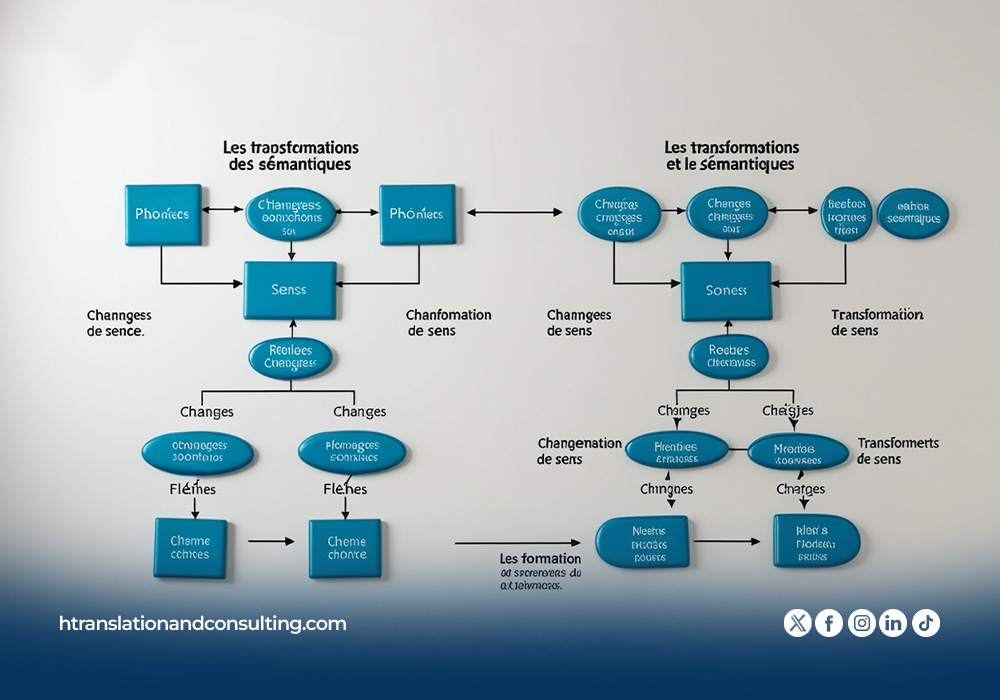
Analysis of the relationship between phonetic and semantic changes reveals that these two processes are often interconnected. On the one hand, phonetic changes can influence how a word is perceived, which can lead to a transformation of its meaning. A relevant example is homonyms: when two distinct words become phonetically identical, it becomes necessary to differentiate them semantically, either through a change in meaning or through lexical modifications. On the other hand, semantic changes, by broadening or modifying the meanings of a word, can also generate phonetic adaptations to reflect this evolution.
In-depth study shows that phonetic change can precede or follow semantic change, depending on historical contexts and sociolinguistic conditions. When phonetic changes precede semantic changes, these are generally unconscious processes resulting from usage and the simplification of speech. Conversely, semantic changes sometimes precede phonetic changes in situations where a word acquires a new meaning that requires phonetic adaptation to distinguish it from its previous meanings.
Case studies illustrating the interactions between changes
To illustrate these dynamics, let’s take the example of the evolution of the word “knight” in English. This word comes from the Old English “cniht,” which originally meant “young man” or “servant.” Phonetic evolution led to the loss of the initial pronunciation of the consonant /k/, resulting in the current form “knight.” Simultaneously, the word’s meaning became specialized to designate a man in armor belonging to the nobility. This example shows how a phonetic change accompanied a shift in meaning, both being linked to social and historical developments.
Another relevant example is the French word “garçon” (boy). Originally, this term generally referred to a young boy or a servant. Over time, under the influence of social context and linguistic usage, “garçon” acquired a specialized meaning to designate a waiter in cafés and restaurants. At the same time, phonetically, oral usage led to a stress in the ending, reinforcing the sound of this term in informal speech.
Theoretical and methodological perspectives
These examples highlight the importance of an integrated approach to the study of linguistic change. Theoretically, several schools of thought have attempted to explain these phenomena. Structuralists emphasize the notion of a “linguistic system” in which phonetic and semantic elements are interdependent. Thus, a change at the phonetic level must necessarily be compensated for at the semantic or syntactic level to maintain the coherence of the system.
For their part, sociolinguists emphasize the role of social and historical dynamics in shaping linguistic change. Phonetic and semantic transformations often reflect new social realities, new practices, or intercultural contact. Thus, changes in the meaning of a word can result from cultural appropriation or exogenous influence, while phonetic changes demonstrate the natural adaptations of language within a community.
Conclusion: Linguistics in Motion
The study of the relationship between semantic and phonetic change highlights the dynamic and adaptive nature of languages. These changes are not isolated phenomena, but manifestations of a complex system in perpetual transformation. Understanding these interrelationships not only sheds light on the history of languages, but also allows us to grasp the mechanisms at work in current linguistic evolution.
This article aims to demonstrate the importance of the interdisciplinary approach in linguistics, a perspective that considers languages as evolving systems shaped by both internal and external influences. This research opens avenues for new comparative studies between languages, as well as for practical applications in fields such as language teaching, lexicography, and the preservation of endangered languages.
Jocelyn Godson HÉRARD, Copywriter H-Translation